Opening the door and walking through it with you

A reflection of two separate trips that served as canon events in my maturity as a person with a Native American identity and a vocation involving mentorship. I hope you enjoy.

Numerous papers and articles have been written about “mentorship” in mountain pedagogy—I even have a few drafts in my Google Drive. Rather than put my own spin on the fraught history of mentorship for marginalized communities, I want to highlight the success and ambition of mentees and the endearing selflessness of peers/ friends during two particular trips this spring. Hopefully, this will echo in the future wherever guiding brings me. At large, mentorship is the turnkey to learning to interpret the story of the backcountry for skiers and split boarders. Indeed, there are numerous books and online resources out there, although there is no replacement for the human element. Whether one is beginning their backcountry touring journey or endeavoring to ski-mountaineering on a volcano, acquiring a mentor behooves one’s safety; finding one is another story. Considering my path largely lacked formal mentorship, it has been my focus with my position at Climbers of Color. My driving ethos has been to create a program I wish I had at any point in my progression. The first spring trip, which I want to highlight, was the third iteration of a hut trip for Native Americans/ Indigenous People. The second was the culminating trip of my Backcountry Leadership Initiative, a winter-long peer-mentorship program opening learning pathways to more advanced terrain and skillsets for the intermediate-advanced backcountry skier/ split boarder. Two epiphanies revealed themselves to me Throughout the seven days between these trips. A newfound levity washed over me during the Native Hut Trip, and a tempered confidence was rooted during the BL trip. 
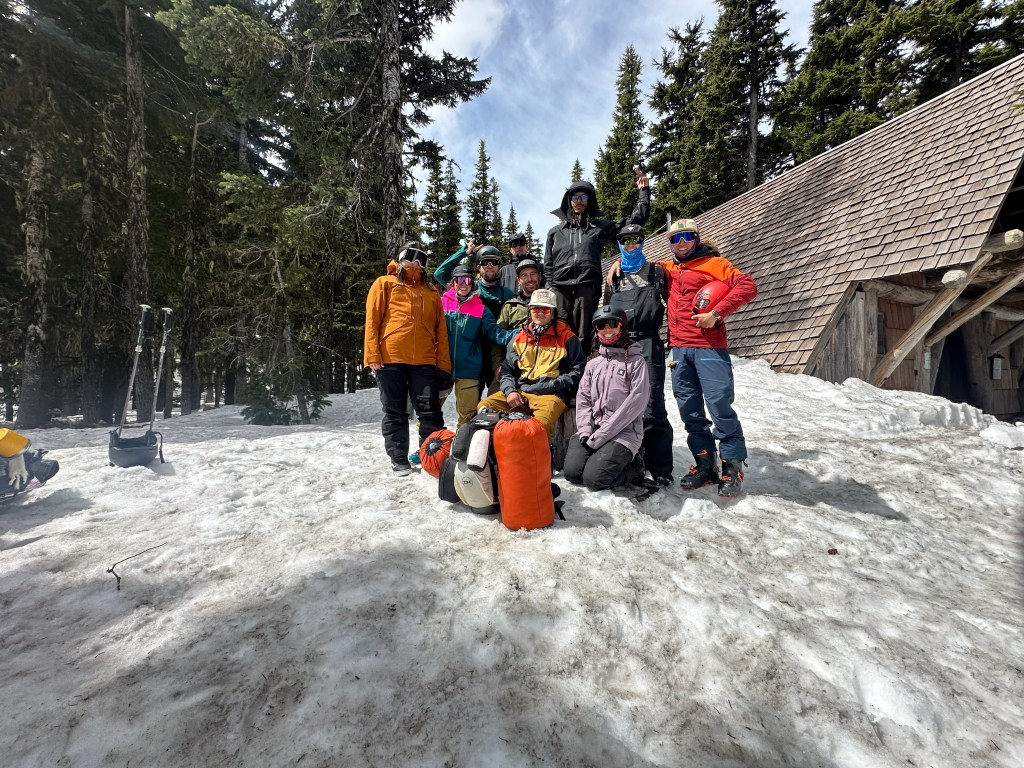
L/R top row: Candace (orange), Brenda (pink), Tucker (beard), Chase, Seth, Sage, me (orange) L/R bottom: Hoon (tucked in behind Dakota), Dakota, Ellen (purple)

Hood River, Oregon, is an outdoor recreator’s dream and a simulation of a town. Impeccable access to a variety of activities, the town is quaint in size and not readily friendly to the transient lifestyle guiding lends itself to. Consequently, it is the closest town to the Tilly Jane Hut, where the Native Hute Trip would be operating out of; thus, I found myself doom-scrolling in the Safeway parking lot at 1900 the night before the trip began. Ironically, my friend Brenda, also the other guide on the trip, unknowingly parked behind me. Ringing me up, we giggled at this chance encounter and soon enough found our way to a local ramen house to catch up. It would be credulous not to mention the air to our mood was saddened– a dear friend and mentor to Brenda, among many others, myself included, Rob Coppolillo, had just passed away in a work-related accident while guiding. In 2022, the first year of this trip, my friend Luke Wilhelm died just before this trip. I had received the news while recovering from a migraine while dirtbagging at Brenda’s house. These two friends were all we could talk about while slamming down our ramen only 20 minutes before closing. A rare air was found in their presence, something we sought to perpetuate into this trip. During the introductions with the group the next morning, unavoidable tears were shared alongside cheerful, short memories of Rob and Luke. This year’s cast featured a few returning folks, Candace and Seth. Rounding out the crew, a collection of Seth’s family from the Blackfeet Nation and Sage from the neighboring Flathead Tribe. Typically, I am the youngest in the group in work settings; however, I found myself among several early-twenty-year-old Native men. The theme of mortality and aging lingered like the gojuchang ramen with Brenda from the other night, each a new yet intriguing spice of life I am learning to unpack. 

Natural groups, paces, and conversations grew as we approached the hut. This stage of establishing rapport among the group is commonplace for any guided trip. Our trip had immense pretexts of many of us being Native. Alongside us was a true ally and friend, Tucker Barney– the show’s leading man. Tucker shared his home, energy, platform, and, most importantly, his heart with the group. After catching up with Candace, Seth, and his brother, Hoon, I found myself in deep discussion with Sage and Dakota, two of the youngest folks in the crew who expressed much interest in all things mountaineering, from guiding to ski-mountaineering. Our conversational flow quickly landed us at the hut, and I had not thought much about it. Yes, I was excited to share as much as I could, especially with folks younger than me who were eager to learn. But, it was not until later that evening, when I returned to conversation with Brenda, that it finally sunk in. One of my favorite things about Brenda is her ability to curate group communication that spreads naturally to vulnerability. Under the heat of many eyes and a glow from the stove, I shared a newfound sense of calmness settling over me. Their eagerness to learn and hungry ambition saturated any excitement– my duty as a catalyst was served. I am still quite excited to see where they go and what they do, but I did not realize it would be so calming simultaneously. Not only did we achieve the handoff of the torch, but now we have more hands carrying it forward. At the beginning of the trip, my good friend Ellen of the Tlingit expressed her gratitude for opening the door and walking through it with this group. Seldomly are there large groups of Native/ Indigenous folks in the mountains together without active oppression at hand. Only celebration was found here.
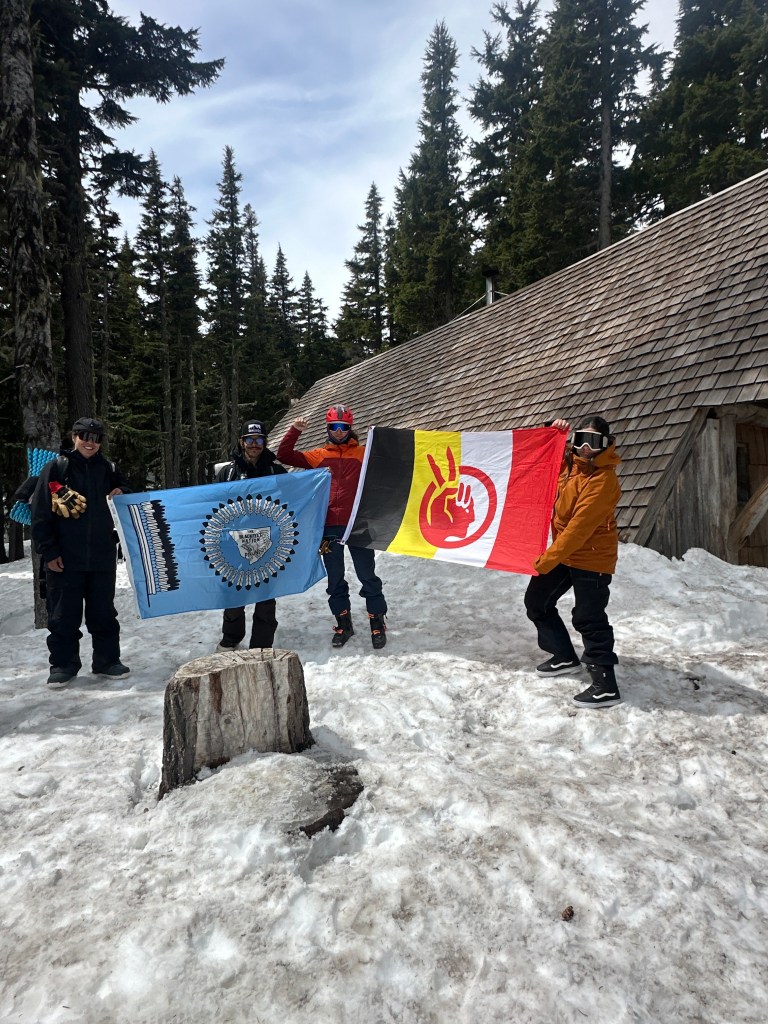
Chase, Seth, myself, and Candace representing with the Blackfeet Confederacy Flag (blue) and the American Indian Movement Flag (red)

Backcountry Leadership Initiative 2024 Kulshan ski/split descent

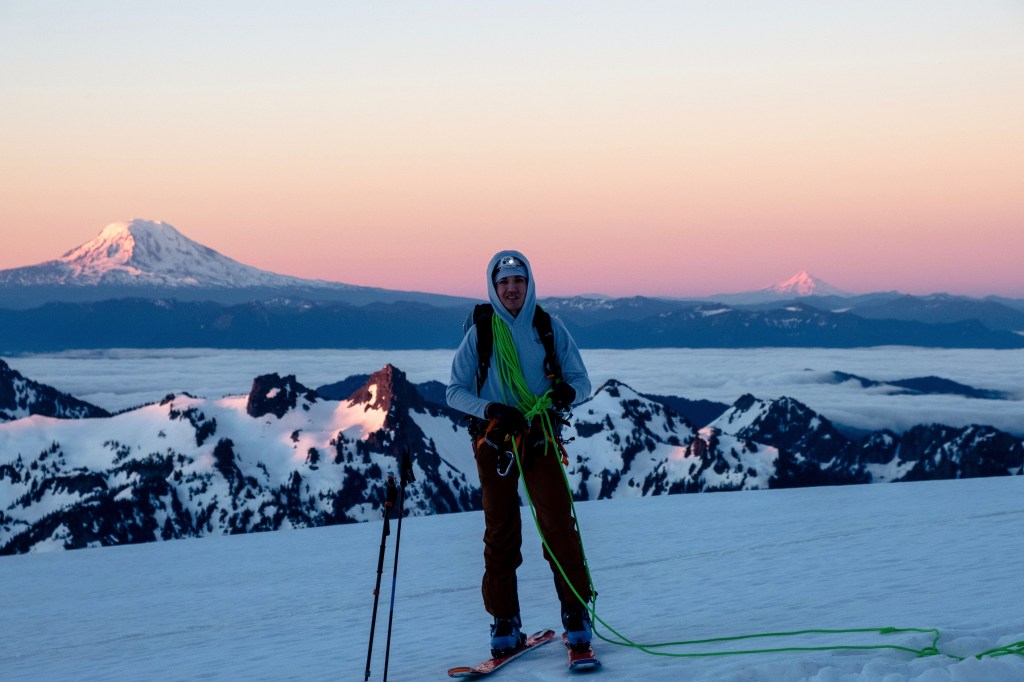
The volcanoes of the PNW are highly coveted, sought after, regarded, etc. There are not enough superlatives that may be expressed about these energy magnets. Grandiose in stature, esteem, and relief, I would rather only ever ski volcanoes than only ski powder. The first time I climbed Pahto, I recall a group of skiers jetting by me and having an explosion of jealousy at my knees. If you have walked down a volcano, you know the feeling. I knew if I were to continue indulging my obsession with the mountains, I would need to take up skiing. Feverishly pursuing skiing and its rules of engagement, I took quickly to it in the dreary Seattle winters. Soon enough, I saw poor mountaineers walking down Pahto with exploding knees. Considering my deep background in mountaineering at this point, the transition to skiing volcanoes was natural; after all, the desire to ski down them was the catalyst of my passion. Throughout my guiding career and pathway to instructing AIARE programs, I observed stark learning gaps between an AIARE I/II student and someone who had skied a volcano. Indeed, one can take courses to “hack” these learning gaps, but I operate under the lens of DEI internal to the outdoor industry. Accessibility is my nemesis, along with white folks who use the phrase “let’s have a pow wow.” Upon assuming the role of Director of Winter Programming with Climbers of Color, I was keen to service this gap. Also, I selfishly desired a way to spend more time on the volcanoes with skis on my feet. In my first winter season, 2021/ 2022, I landed on the position with a skeleton of a program already made and not much time nor budget to allow anything new to take flight. For the 2022/ 2023 winter season, equipped with new funding for the organization and a fresh map of ideas, the Backcountry Leadership Initiative (BLI) was born. 

The ’23 BLI final trip on the summit of Takhoma with Eric M. & Eric L.
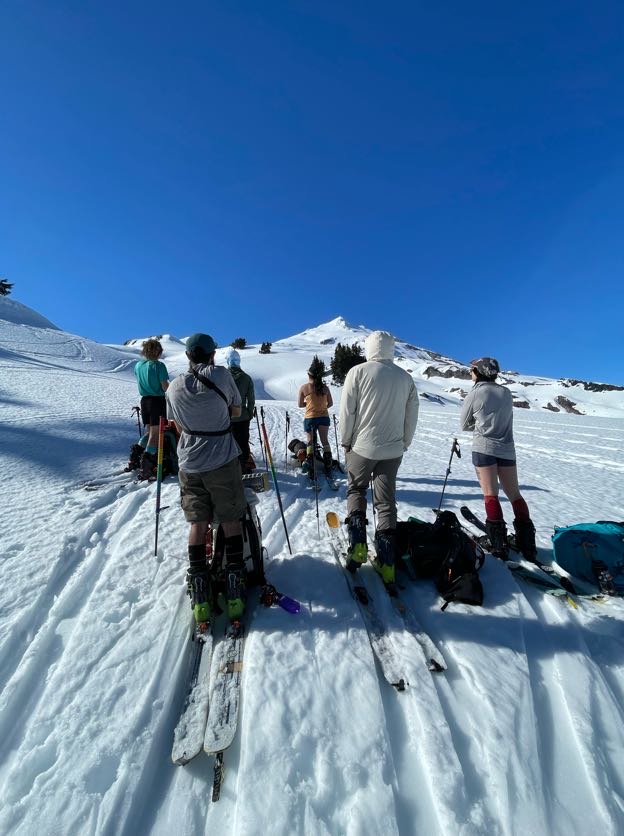
The 2024 cohort looking on to the upper Squawk Glacier. Our camp is just above the height of our heads here.

Initially, the mission of the BLI was to get folks into ski-mountaineering and more advanced terrain like couloirs or slopes steeper than 35*. With critical success and luck, the first cohort ended the season with a summit of Takhoma and a ski descent of the Fuhrer Finger! However, a small team of three undoubtedly contributed to the success– I desired more folks to come through the doors. As word caught traction and the entrepreneur inside of me grew, the latest season sported 12 participants, of which six became solidified throughout the season. Considering the program’s focus on peer mentorship, season-long feedback had come to fruition for this outing. Upon the feedback from the cohort, the new approach for this finally was to have a pair of folks work together on individual components of the plan. Between timing, route, and execution, everyone was involved to some capacity in forming the trip utilizing lessons from throughout the winter. After a fun hiccup of inspiration from my end to convince a massive trip shift to Takhoma, we found ourselves at 6,000’ below the Squawk Glacier on Kulshan. 
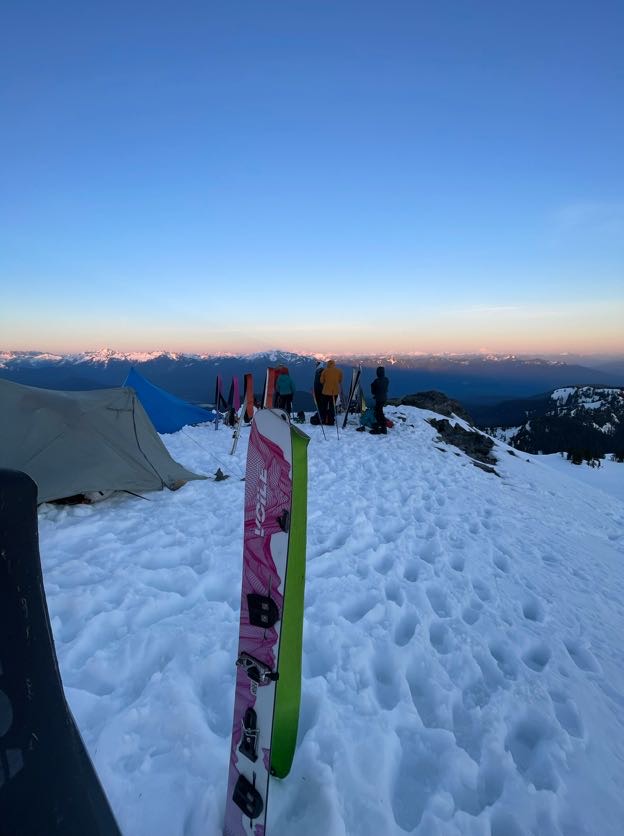
Camp views to the East looking into the N. Cascade Nat’l Park

Settling into our snow camp with views into the N. Cascades, I rummaged about while the team deliberated the time plan and execution for our summit and ski bid. This gathering excites me the most: a mid-size team coming together to plan a new, unknown adventure, implementing various skill sets with the end goal of type-1, knee-saving skiing/split-boarding. For most of the crew, it was their first time saddling up to ski a volcano; although, everyone had climbed one on foot– not every layer was unknown. While the team hemmed and hawed, I bit my lip. Ultimately, the six person crew deliberated rather efficiently and concluded for a 0500 departure under the Northern Lights! Primary goals included summitting as a team, then, pending conditions, ski the Boulder Glacier, or our ascent path, the Squawk. The remainder of the evening was spent packing in a flurry, and soon enough, we rolled our buffs over our eyes as we attempted to sleep at the spry hour of 2000. 

Northern Light alpine-start, it does not get better than this!
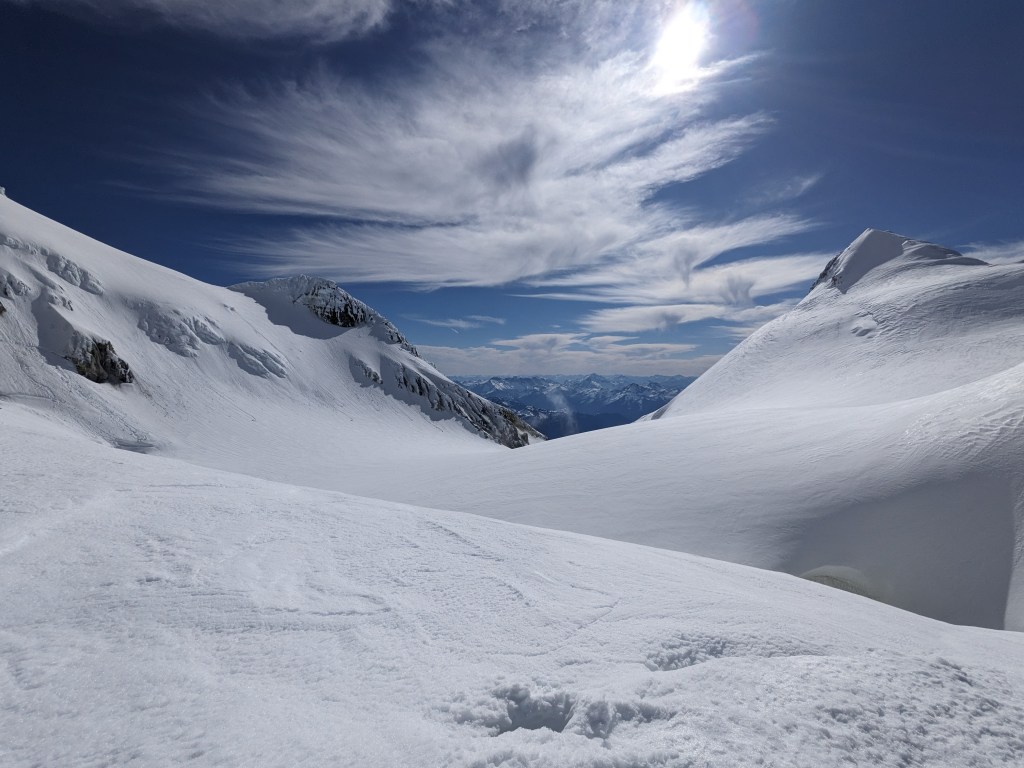
Looking across/ above the Sherman Crater, the Kulshan summit is left-center just above our descent off “The Football Field”

Alpine starts such as this are hard to not be exciting; especially, when there is a light cascading above that moves and breathes like a sea creature. We would spend several minutes prepping then lose focus observing the solar-flare induced Northern Lights– what a treat! Dawning our action suits, we began the ascent from 6,000’ up the Squawk. Although I had intended Aivy & Manny to lead portions throughout the day, it felt pertinent to lead out the gate considering the firm surface conditions and long slide potential. Uneventful movement carried us all the way to the Sherman Crater at the base of the Roman Wall. A quick section of short roping dwindled giving way to a glorious boot pack straight to the summit. As the revolving door of skiers and climbers made the summit pic rounds, we carved a space out on the summit plateau. Discussing with the team, we felt keen to give the Boulder Glacier an attempt, but, someone had to be the ginnie pig for a surface condition check. Considering I had the most experience with glaciers and skiing them, I found myself shuffling over to the Southern edge of the Football Field toeing the line of regret and excitement. Standing by on the summit, Manny prepped his camera in the chance the conditions were green lighted. With the checker flag waving I dropped in. Quickly, I found conditions quite favorable, carvable corn above the Sherman Crater with the May sun beating down, I was all smiles and hollers. 
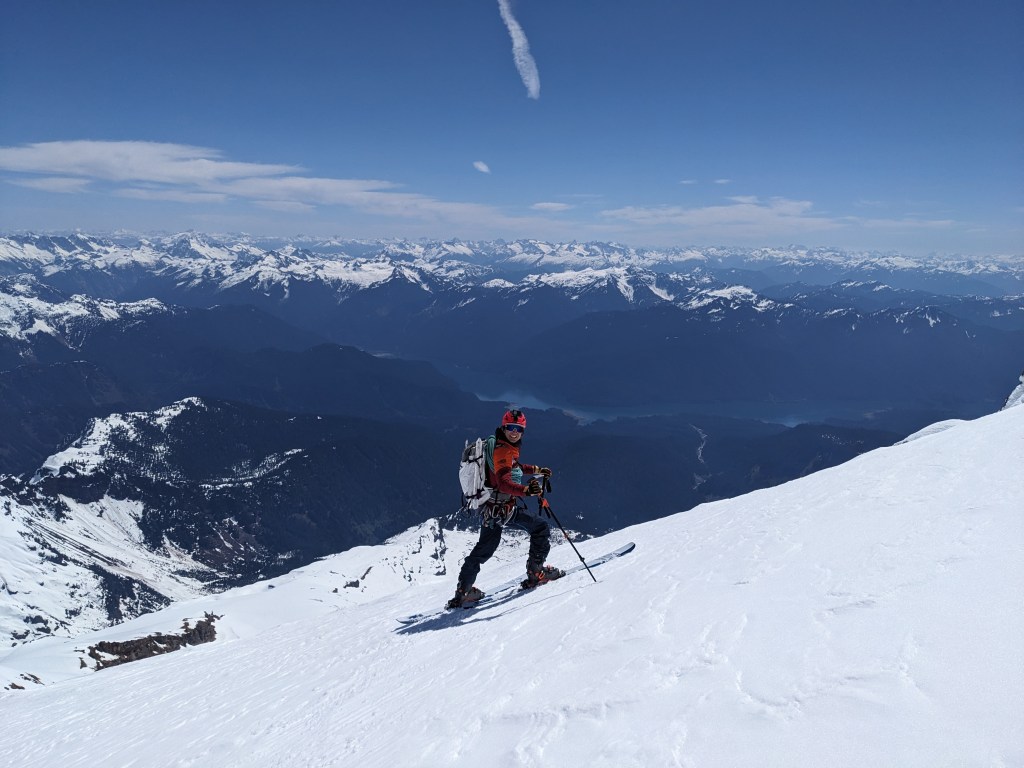
Cheesin’ as I descend the Upper-Boulder
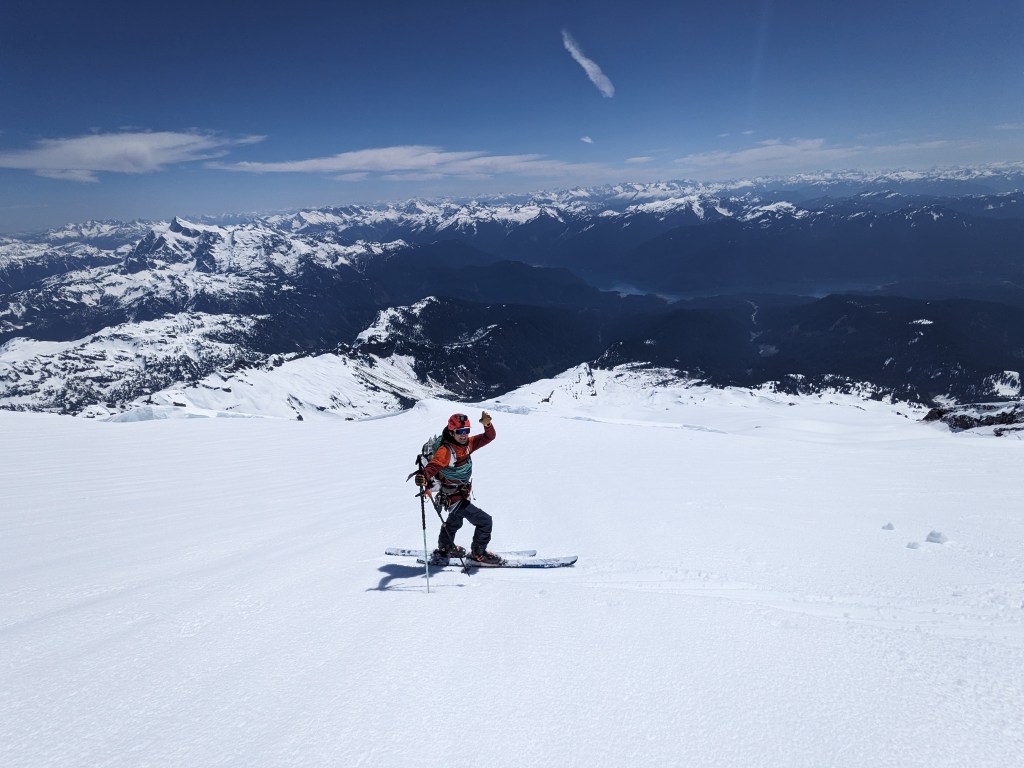
A full-guide-mode Cal’

As each person made their own descent, euphoria set in as we felt the beginning of “we are going to pull this off!” With an unconscious tone change but a real conscious risk awareness my “guide mode” was activated. Picking the way down through the Upper-Boulder Glacier a few crevasses and descent considerations revealed themselves, especially for a group of this size with a number of newcomers in this terrain. I have felt this surge of focus and awareness a handful of times in my guiding career. Most of the time it comes in a good flow of teaching skills in a safe environment simply standing at a campzone or a crag. Never before onsighting a ski descent with a team of five. Pressing forward, we broke the descent into decent-sized chunks of visibility and safety, each stretch roughly 500’ of delicious corn! Whooping and hollering we enjoyed a collective 3,000’ off the summit to the unknown crux of the day, an improvised rappel and downclimb. Consulting with the team, we concluded it would save a 2,000’ ascent later in the day and, it would be an exciting cherry on top to round out a proper ski-mountaineering day!
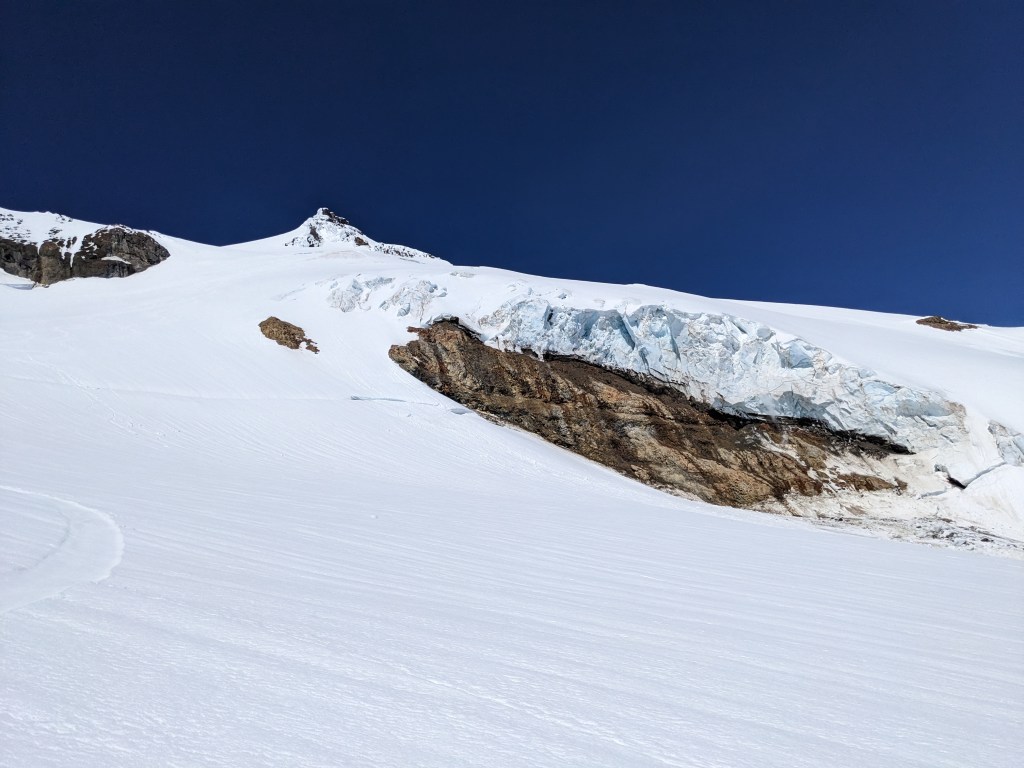
The Upper-Boulder Glacier. Our descent snaked through large, obvious crevasses.
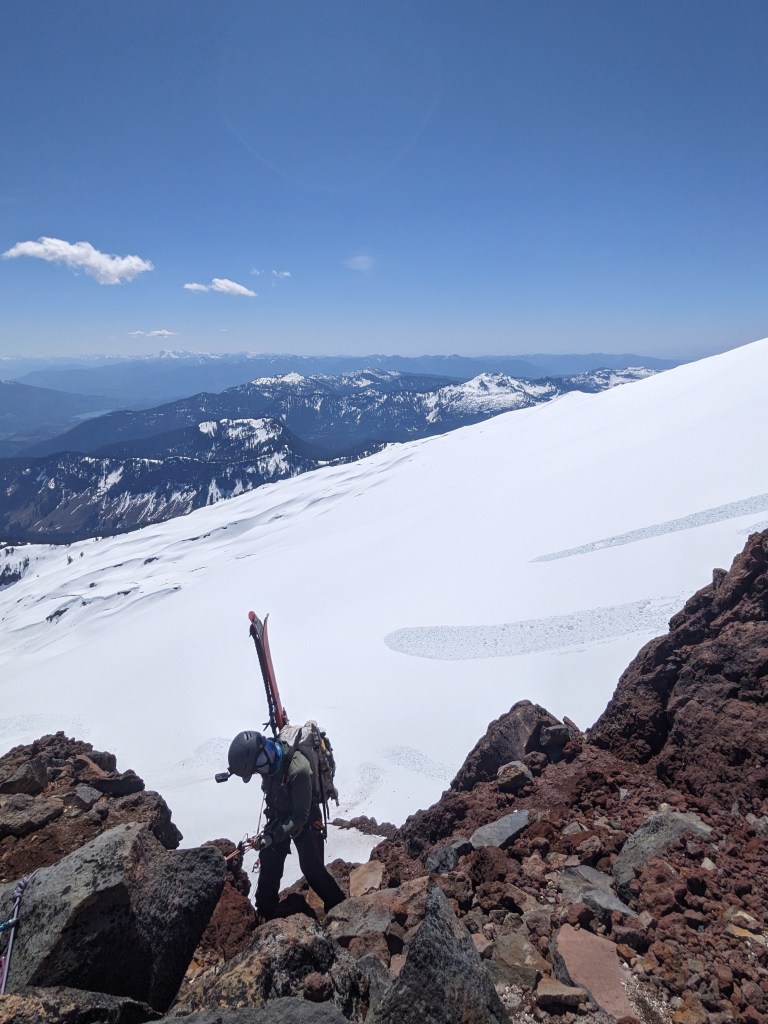
Manny beginning his rappel. Our egress traveled through the toe of the avalanche paths to the ridge in the distance for a mellow 1,000′ descent straight into camp!

I continue to navigate waves of imposter syndrome leading up to this trip as the AMGA undergoes intense Standard Operating Procedure (SOP) bouts. Effectively dictating who is certified to guide in XYZ terrain. Long story short, I agree but also disagree, considering the myriad of barriers for myself and folks in this cohort, including the broader marginalized mountain athlete community. Whenever I would get too bogged down, I affirmed myself of a few reality checks. One, guiding has been done long before the AMGA has been around, and it has been done by people from my tribes and other Indigenous groups the world over. Two, this basis of the BLI is peer/cohort-led; I just happened to have led the more technical portions. Finally, every step was a group call, and the trust had been nurtured throughout the new year until this date. I do not normally enjoy loading my writing with the following language, but the community takes care of itself, and the larger AMGA community is disparate from my community’s needs. To me, the continuation of this group and program is a tremendous success for the advancement in technical backcountry touring, and a summit descent is just the cherry on top. It behooves leaders in these spaces to give a hand up to their respective platforms as they make room.

Looking ahead throughout my guiding season, I have a particularly juicy June ahead. My RGC, hopefully, two trips to WA-Pass, one to Boston Basin, and a large family reunion back on the Rez which means more Tieton! Then, July will feature an intense 10-day stretch between Kulshan and Takhoma, either a trip to Boston Basin/ Twin Sister Range and another family reunion but in Tulalip this time. Finally, rounding out August, my lovely partner, Amber, and I, have a week trip to the Valhallas in BC and other various mountain/ summer activities planned. I hope to get more trip and thematic write-ups like this out every five weeks or so. Stay tuned!
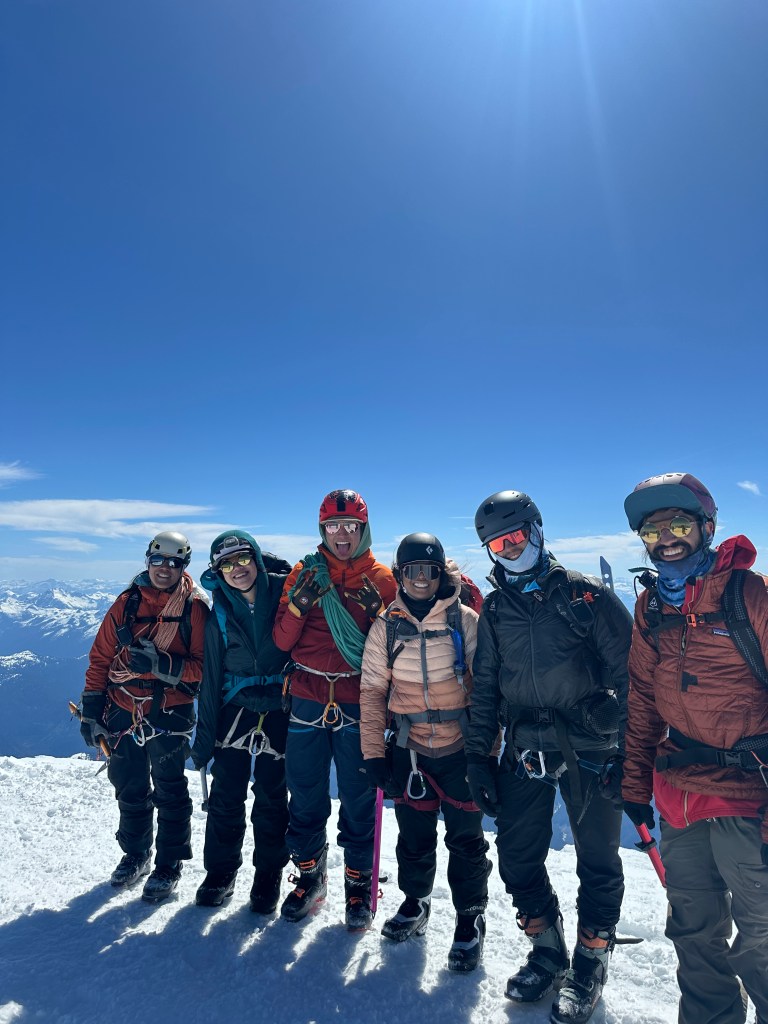
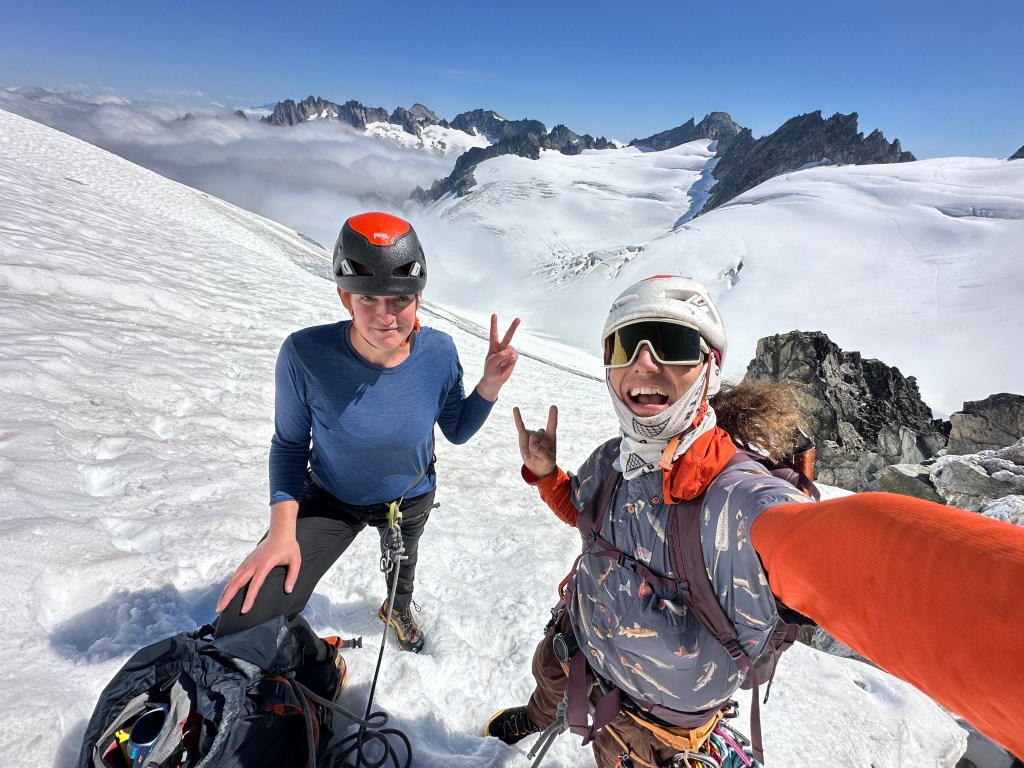
L/R: Aivy, Keira, myself, Char, Manny, Rishi
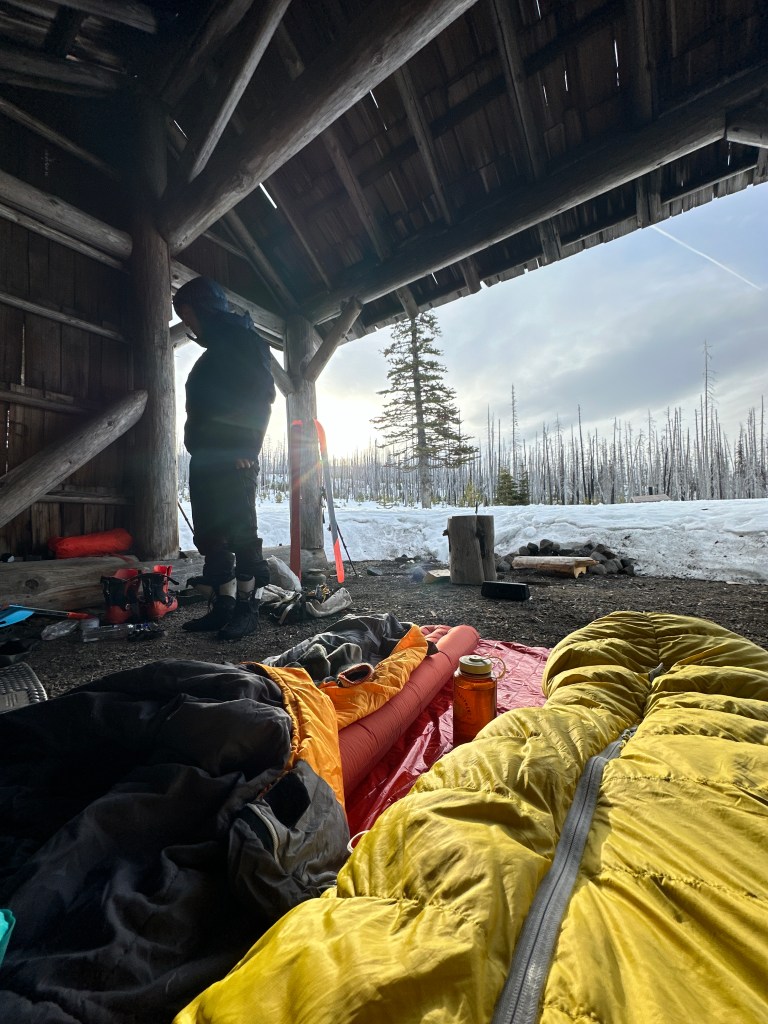
Pahto-Tieton Slam

Pahto’s SW Chute at Sunset and more Tieton fun with Carter!

4/8 – 4/16

Throughout March, Amber had been traveling in Pakistan visitng her family so I was dog-dad for a few weeks. Upon her return, she bopped down to Santa Fe to visit our good friend Lauren and to work on her dissertation. Relieved of doggy responsibilities, I jetted over to Yakima to visit Carter ahead of another trip to Pahto! The weather on the East side proved spectacular and immediately upon arrival on 4/8, we zoomed down to Tieton. I had just climbed there for the first time over Halloween and was frothing to return! Between the stellar climbing in Tieton and our upcoming trip to Pahto, it would be around a week of mountain activities on my homelands! What a treat =D!

Wicki Shelter bivvy
Wicki Shelter bivvy

For the trip to Pahto, we had a team of three: Nolan, Carter, and myself. We faced interesting weather conditions the first two days, 4/11 & 4/12. Landing at the Wicky Shelter the night of 4/11, we got lazy and enjoyed the structure and dirt sleeping rather than pushing the final mile & 1,000’ of gain to our camp we made on the St. Patrick’s Day trip. The weather on 4/12 began with beautiful sun and skies as far as the eye could see, making for an easy time to construct camp and of course, sun tan! This time, we made camp around 6,500’ above our previous spot. After some time building out party tent, it was 1130 so we decided to walk up the mountain and see what we could find. The forecast listed mostly cloudy and rather stormy conditions for the meat of the day but we were keen to see what lemonade we could find. Arriving at Lunch Counter around 1430, Carter had pushed ahead so he could melt snow, while Nolan & I trickled in. Adjusting and fittling with gear and boots, Carter quickly disappeared into the now rolling whiteout. After some indecisiveness and chat with Nolan, we decided he would go down and I would go up. Having been here dozens of times before, it was my first whiteout experience on this feature and it was exciting. Tromping upwards with Portishead blasting in my headphones, I kept count of my steps and occasionally glanced at my GPS to ensure I wasn’t about to walk off the Mazama Glacier Headwall, due East of the Wall of Death. Some 30 minutes later, the rolling whiteout revealed itself to be a massive cloud moving across the Wall of Death as if it were a ship charting its way through Pahto. By now I had located Carter’s skintrack and further up, he was foolishly booting. I cannot blame him though, during our St. Patrick’s Day trip, I succumbed to a perceived imbalance forcing my fold and I succepted to the trudging booter. Undoubtedly, extremely tiring compared to the sailing flow I found skinning. Quickly stopping for another break on the shoulder near 10,800’ above the Mazama Glacier, we admired the fleet of clouds rolling through with the crimson sun beyond. By now, it was somehwere near 1700 as we encroached Piker’s Peak. My longtime goal of skinning to the summit was becoming a reality and another rare occurrence happened, I gapped Carter. Whether he was having an off day, or got wrecked by booting, there are few times I have gapped him in the mountains and it is a fun measurement of my fitness when it does!

Broken whiteout with Carter higher up.

Surmounting the false summit, I pressed my gap on Carter to scout out the Avalanche Glacier Headwall for the future. After some libations on the summit and harassing Carter to snap a photo of me, he quickly jetted down claiming to be freezing and worked. I enjoyed several more minutes of solitude atop the Yakama Reservation prepping for the firm sunset rip. We agreed to ski the South Spur although, I claimed intent to scope out the SW Chute… as I rolled by I noticed tracks and a wicked fast skier descending near the end. Surely, it had to be Carter! Impulsively, I dropped in, enjoying rather favorable recycled powder for the first 500’ or so. Then, then came icy-chicken-head firmness from Asgard! Constantly I was switching between the separate chutes hunting for more optimal conditions; but, all I found was consistent P+ firmness which began waxing away my nerve. Once I remembered I was cramponless, I decided to traverse over to the South Spur out of fear of falling, losing a ski, and being forced to trarvel with one ski. Certainly not ideal in a slide for life chute with 3,000’+ of mountian below me. As much as the traverse over was sucked, it immediately alleviated my stress; albeit, the sunset was something I will never forget. Slip sliding my way down the South Spur was equally as challenging although not as steep, I dropped down skier’s right to make the end bits of the SW Chute, directly above our camp. Several hundred feet of the stickiest snow lay between camp and destressing libations. 

Breathtaking colors and ski conditions will be a canon memory on one of my home volcanos ❤
Camp chillout day

The next day we rolled out of bed sometime around 0800 enjoying sleeping in. The forecast called for exceptional weather although, by the time we arrived at Lunch Counter below a dozen other climbers + skiers, the winds were relentless. Feeling scared, and scarred by the scoured SW Chute, we decided to return to camp enjoying a ski of the Crescent Glacier. For the remainder of the day, we buffed out our tent site enjoying Carter’s B-Grade rum, and sun tanning. Sometimes you climb the mountain, and others, the mountain climbs you. With only one remaining day on the calendar, Carter and I planned to ascend one more time while Nolan left early to catch some downtime before work on Monday. Another similar day occurred up to Lunch Counter and beyond. Chug along for a few hours, stop brew water, then chug along more. Atop the summit, Carter and I soaked up our final views for the trip in stellar warm weather. Yet again, Carter was eager to not linger and begin descending. After I failed to convince him to ski the Avalanche Glacier Headwall, we decided to meetup at camp separately. I cannot deny I felt nervous to onsight descend a new route alone, although I knew the mountain, conditions, and had reliable mapping so, it was a matter of gathering the sand to get it done. Clicking in and questing for the appropriate drop in, I had to snake my way through pearlescent rime towers. Eventually, I found the broken link between the pearls, bursting through the clamshell headwall, I found the Avalanche Glacier Headwall! The initial 1,000’ or so were quite mellow; then, entering the gut, I found 40*+ slopes upwards of 2,000’ long. Quite similar to the SW Chute with maybe 25% less sustained route however. By this point in the trip, I was feeling it. The 1400 sun exposure and temperature had made the snow a bit beyond favorable, edgeable corn leaving me taking periodic breaks every 500’ or so. Eventually, I realized there was a substantial traverse I had to make. Spotting a landmark out in the distance and bottoming out some ridge skier’s left, I began the traverse from W to S. Although the terrain was not as sustained as SW Chute, the setting and scenery were spectacular; and hey, I was afforded/ privileged to ski a new route to me on my home volcano! A suprisingly quick egress to the car from 1700 to 1800 got us home to Yakima and a large Mod Pizza in my belly by 2200; all in all, it was 20,000’ over 40+ miles for the weekend only 60 miles as the crow flies from the Palm Springs of Yakima!

The Avalanche Headwall, much further W along Pahto

Awaking the next morning, I was eager to hit the local gym, High Steppe. If I’ve mentioned it to your, I’ve expressed how high quality it is. Quickly after arriving and grinding through my warm up, Carter and I left after maybe five routes climbed. The fatigue set in and soon enough, we ended up back at his house. Looking ahead to the weather the next day, Tieton climbing looked favorable with warm-enough temperatures. In preparation for my RGC, I convinced Carter to head back out for another adventure. I finished the trip in Tieton that evening with several TR laps up the impeccable 5.9 Inca Roads which, proved to be a tricky onsight which, ultimately, I succumbed to and aided up all things considered I was quite elated.

Looking down on Ed’s Jam with Carter and Reina following

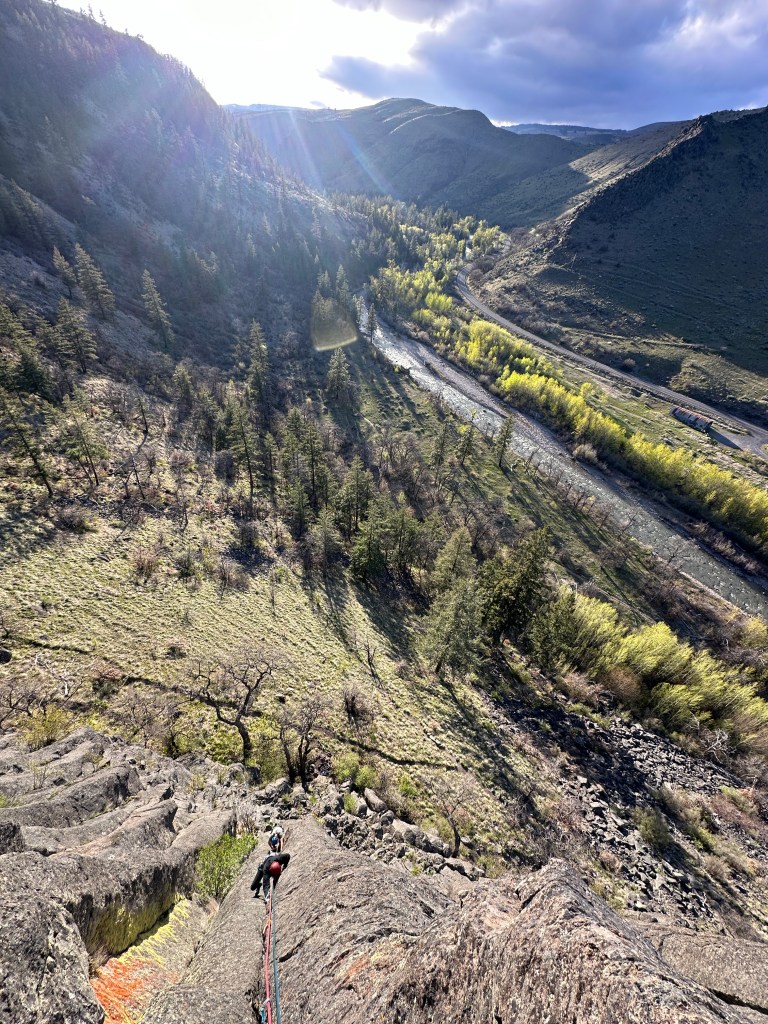
The topout of Inca Road overlooking the Tieton River at sunset 🙂

Getting Rocked in Smith Rock

4/3 – 4/5

A quick 2.5 hours away from my mother’s house on the Yakam Reservation is Smith Rock. Feeling bad for missing her birthday (St. Patrick’s Day), I carved time out to visit on Easter Sunday. After enjoying some freshly caught Yakama Salmon, I bopped down to Smith Rock with Aloo (my husky), to meet up with Cecil, a friend and fellow guide from Climbers of Color. Unfortunately, the stable weather window had devolved into a steadily approaching storm which brought equally favorable overcast and snow on the final morning. Upon arrival on 4/3 around 1500, I was keen to jump right into the climbing and now waste any time. Our first route in mind, Pack Animal 2P 5.8R, really gave me a run for my money. Between a large swing potential with a tiny nut for protection, the traverse into the first anchor made for an exciting beginning to the 2024 rock season! Pitch 2 looked not too bad although, in classic fashion, it is always steeper than it looks. Navigating two bulges with okay-feet, the wonky tuff of Smith proved engaging protection not readily good. Through some effort and grunting, both Cecil and I made our way up and were excited to get back down. Retreating to my favorite BLM spot above the Deschute River, we feasted after our spicey 2P adventure on day one; surely, it was going to be an exciting trip. 

Tongue out for Chouirnard Crack – it was awesome albeit short lived

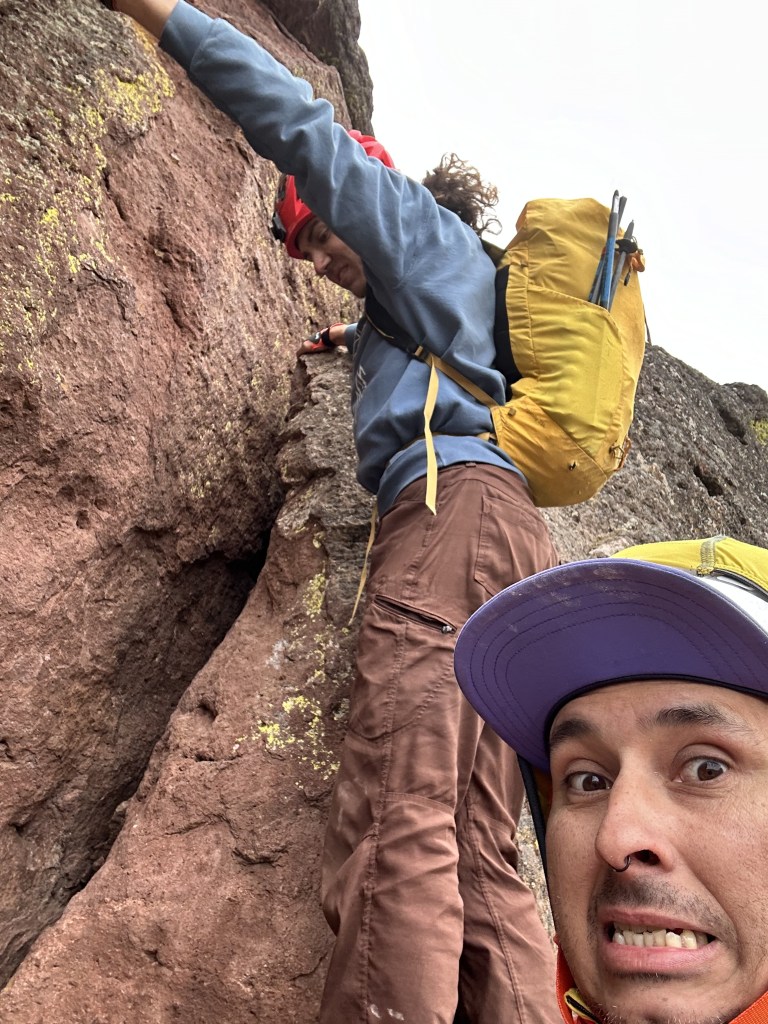
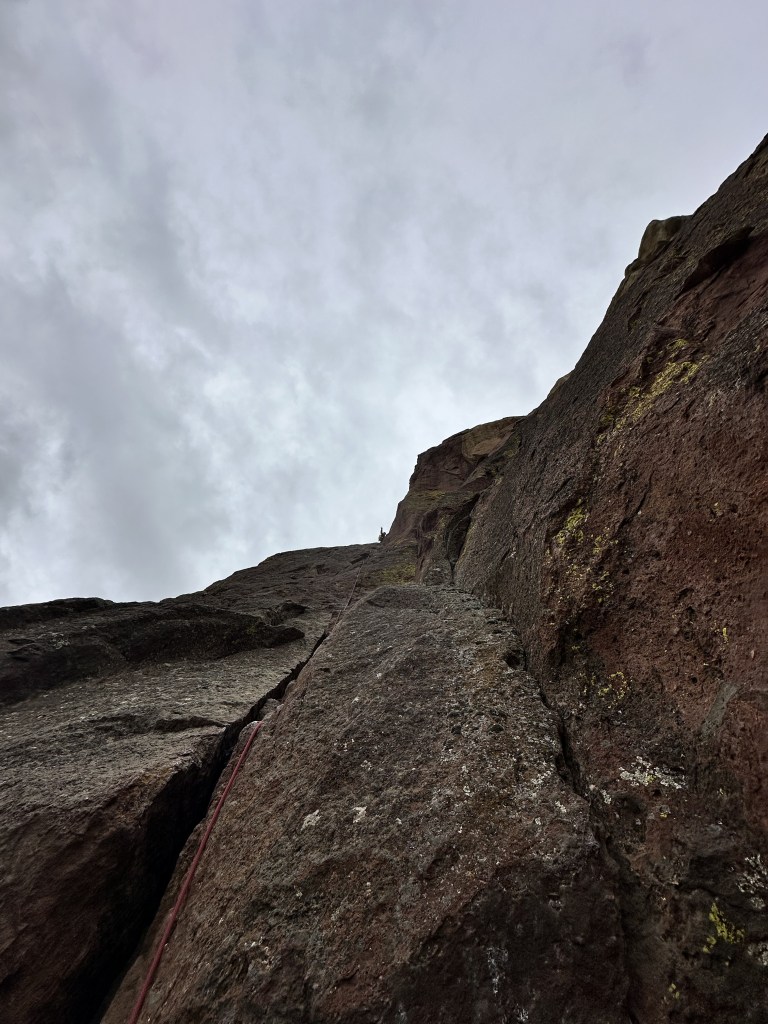
Over the next few days, Cecil and I absolutely quested up a few more trad multipitch routes in preparation for our Rock Guide courses this year. Mine is at the end of May at Smith Rock, Cecil’s in Leavenworth at the end of the summer. Although we managed through the routes, I can’t say I felt as good as I had hoped on routes only up to 5.8. Sky Chimney 3P 5.7 proved to also be more than we anticipated. Cecil ended up lowering off just before the pedastal, while I took over and linked P2 & P3; it made for some wicked rope drag up high around the #4 bulge. A key purple totem did however, alleviate much stress of quite the whipper, I will have to remember this placement. Other notable routes we did were Cinnamon Slab with the Chouinard Start – fantastic link up! Then Super Slab in deteriorating conditions to finish up the two days of climbing. Although it had not been as long as we had hoped or planned for, Smith Rock provides readily accessible climbing in a superb setting; albeit, old school in the rating I would say.

Glad to have Cecil’s levity!

Super Slab topout!

Pahto SW Chute!

Normally, I like to spend much more time on these, although the necessity to keep up with current events and happenings dictates that I grind this out now in some new and odd floral coffee shop in Yakima. As Spring pops, the weather bursts open and closes just as quickly. I am remembering why I love it so much, the springtime. I have concluded that the weather is good if you are willing to drive for it! Spring for me this year began a few days before the austral winter ended. For several years, I have noticed predictably good weather on the volcanoes around the calendar end of winter. For these outings, I typically link up with my good friend Carter. We grew up together in Yakima and also got into mountain sports simultaneously, so our trips have an extra layer of fun that I always relish. Considering the several days of stable weather over St. Patrick’s Day weekend, we decided to haul overnight packs as high and far as we could regardless of how far away the road was open. Historically, we have been pretty anti-camping, though for some reason, in the last few years, it has decidedly swung the other way; camping is in! It was unfortunate, however, that this approach ended up being the longest approach either of us has done between the collective 50+ trips to the mountain. 

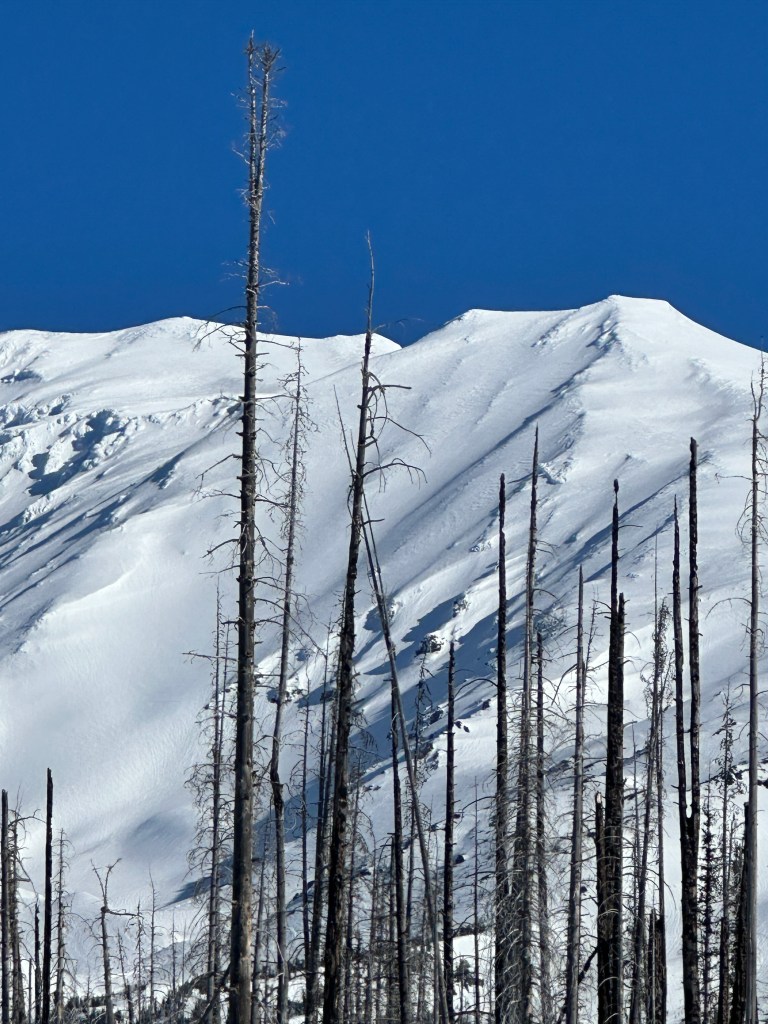
Google maps listed Coldsprings campground at 7 miles although our plan was to camp a bit to the West with our descent of the SW Chute in mind. Just as quick as we fell asleep cowboy camping, my alarm at 0600 went off. Time to begin the slog in the dark. Skinning immediately from the car ended up being quite lucrative for us. After several hours of mundane touring through the flatlands, the forest eventually thins out and everything alive, is now dead and/or burned. Throughout the 2010’s, a series of beetle infestations and fires ravaged the landscape, leaving behind a wonderous ecosystem in the daylight; and a scary hollow looking and sounding forest at night. Nearing the Wicky Shelter, it was only 0900 but it was already bakingly hot, something I thought I had been prepared for. Sludging through the softening snow, we hastily decided to strike camp much lower than we had hoped due to the oppressive heat. In the end, we traveled 6.8 miles over 2,500’ to a camp only at 5,500’ – undoubtedly, it was going to be a full value summit day.  We were both quick to sleep that evening. Although it was the final days of winter, the freezing levels that weekend were nearing 10,000’; so, down at 5,500’ in the sun it was quite the cookout. 

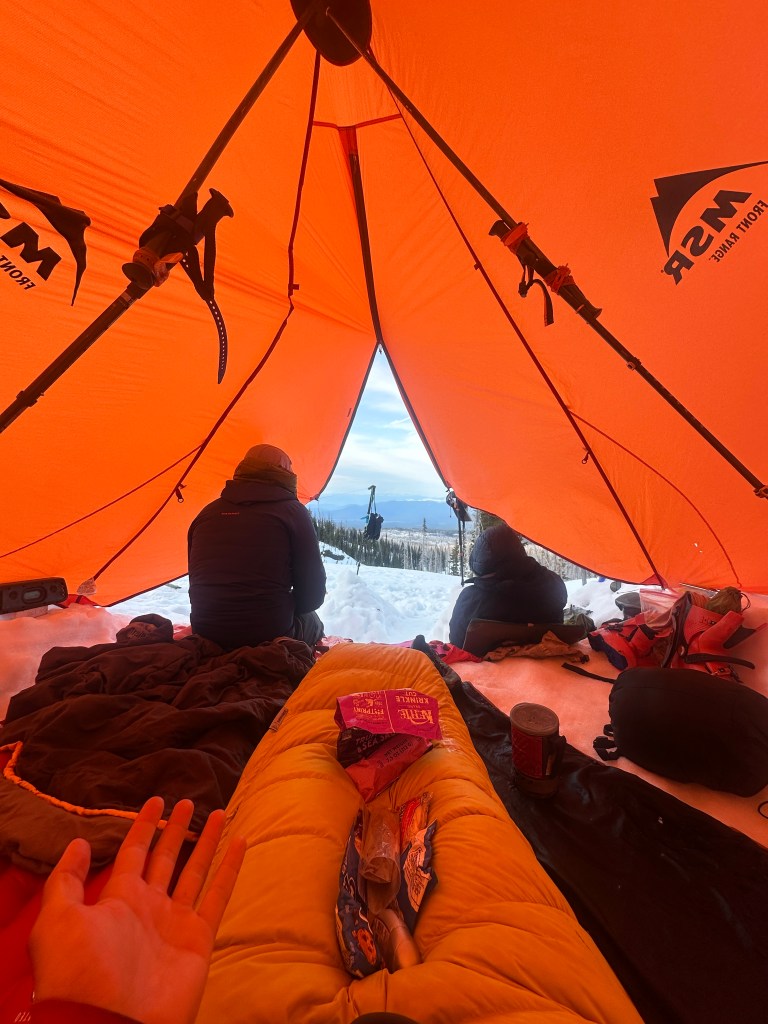
Our tent setup that trip had been Carter’s new MSR party tent. Providing ample space, we slept with the primary doors open. In between lulls of sleep, I awoke to the starry sky of the night, wondering if the were any creatures lurking around. Soon enough, our 0600 alarm sounded as the stoves ignited and sleeping bags wiggled. Traveling the first hour or so via headlamp, we cruised unknown terrain to the west of the summer trail; eventually, stumbling upon someone’s trail from the prior day. Something that has always surprised me about Pahto and the climb of the South Spur, is how many individuals push camp up to Lunch Counter at 9,200’. Effectively, one carries their camp up, and down, most of the mountain with this strategy. Although our camp at 5,500’ felt relatively low, we soon found ourselves at lunchcounter within a couple of hours from departing camp. Some distance up The Wall of Death, the 2,000’+ ramp up Piker’s Peak, we opted for a massive break. Busting out the stove and the little piggies, life was good. Things were looking quite optimal all before I began the next stretch upward from 9,800’. Aside from poor food selection (only sugars), I foolishly left my long underwear on. Each spring I find early season hesitation to hoard warm layers, as my bones from the wet and cold winters are still frigid. Indeed that day, they have been cooked and charred. I bonked the hardest I have in recent memory. Another big mistake I made was choosing to boot instead of skinning. One thing I stress teaching others about ski-mountaineering is, that as soon as we decide to boot vs. ski-tour, we accept moving much, much slower and inefficiently; and so, the damage was done. Classically, I fell behind Carter, trudging up the wall of death; I was physically and mentally humbled, once again by the older brother, Pahto. 

Arriving at the summit 1230, I smashed as much food and liquid as possible in lieu of out descent, the SW Chute. Arguably, this route should be on the 50-classic ski descents of N. America, but what do I know about good ski lines in the PNW? For around an hour, Carter and I, relaxed on the warm winter summit of Pahto. Later on in the summer, the summit and the entire mountain really, become flooded with budding mountaineers, unaware fo the humbling nature of the Wall of Death. We relished being here alone. As the time rolled around, we began descending around 1330. Quickly I began snapping photos of the summit pyramid and Avalanhce Glacier Headwall. We had one more day on the books after this summit day with uncertainty on our plans and I had strong desires to ski a new route. Charging forward, we found our way to the SW Chute and threw down turns on the perfect 45* entrance! All things considered, the skiing was quite amazing per usual in this route, albeit 30-minutes too late. 

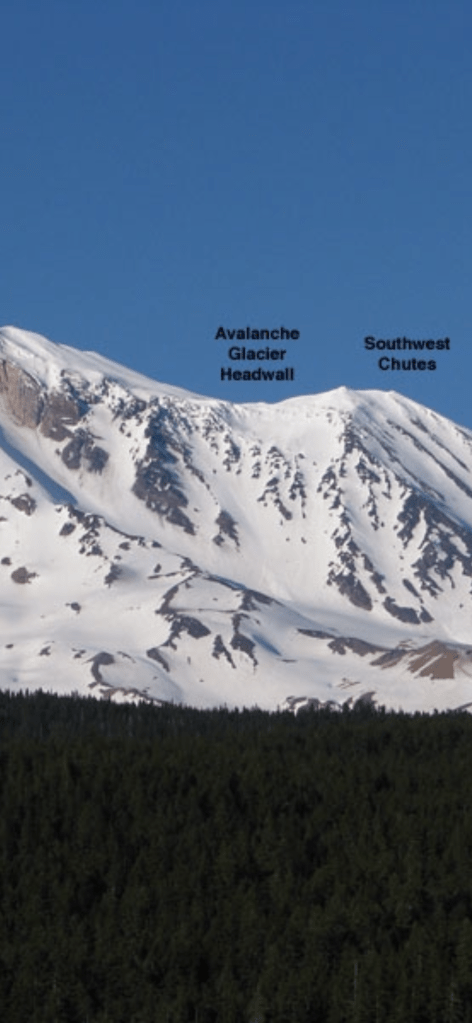
The SW Chute pictured here. We came in from the upper looker’s left shoulder. The Avalanche Glacier is on the L-edge of the photo.

Making quick work of 4,000’ descent, we skid right into camp sometime around 1500; maybe a 30/40 minute descent while taking our time! By now, the snow was mashed potatoes and grabbier than hell down low, we were quite glad to have a camp to loiter and suntan the day away! Normally, I do not spend much time camping in the backcountry on my own time but this was quite luxurious. Enjoying our libations and such, we shoveled out snow-recliner chairs the remainder of the evening. Discussing our plans for the final day, our desires were to go back up again; however, the reality of our fatigue set in and we decided to descend. I was quite bummed to not enjoy the weather up high on the mountain although, the firm conditions traveling back to the car were an epiphany! We traveled the 6.5 miles, 2,500’ in 30 minutes from our camp! This definitely more than made up for the ass-kicking approach a few days ago. Ultimately, we had the mountain to ourselves, discovered a new strategy to ski this route/ mountain (especially in a lengthy approach), and came away a few shades darker; what’s not to love!

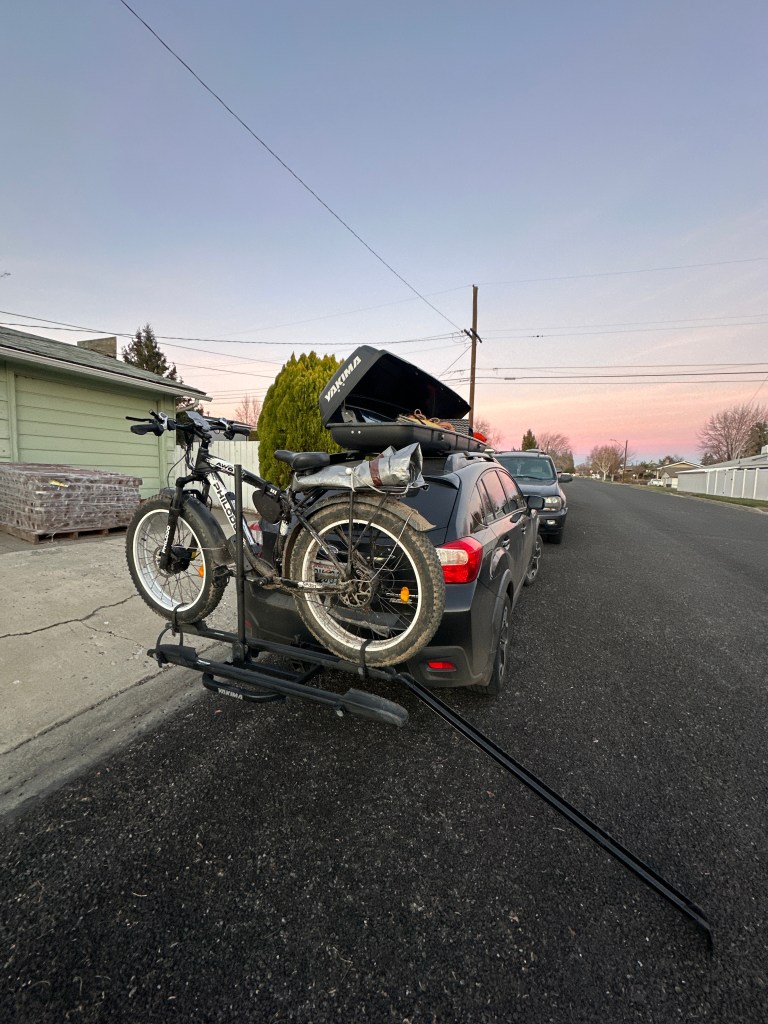
Carter’s impressive bike-ski setup

A Summer’s Madness

Through swirling hazes of candy bar wrappers, granola bar crumbs, and sticky pockets of old snacks, I have spent most of my summer in mountain clothes – painfully dull in style, their only reprieve is function and application. Sixty-nine days between May and September, to be exact, and these are only the work days. I am not even counting my personal days. One of my good friends, Ezra, asks “Cal’ what do you do on your days off? How do you spend your time?” If one reads my bio on Alpine Ascents’ website, you learn of my cafe lurking habits. What exactly is accomplished during this cafe time escapes me; instead, what is done is indulge in the liquid-black gold, soft tunes, and evanescent people watching within the Emerald City. Historically, cafes have been a boon to my mood, psyche, and productivity for anything that demands laptop time. Cafes have also been great creative spots for all of my work. Something about the dynamic jumble prevails in my mind from overthinking into a spiral of moods. Or perhaps my brain functions more acutely when I can write my thoughts down, forcing me to pump the mental breaks. If you know me personally, you will know I tend to talk fast and mumble. Leaning into previous methods of decompression, writing has been something I have always been fond of. Fantasizing of honing my oratory skills, something about a verbal lexicon has always piqued my brain. Admittedly, I must also thank my brother Owen for indulging in writing and pursuing an MFA. It has been some time since I have enjoyed a good mental brain vomit, and frankly, I have yearned to reflect on my trips with more fervor. Too much has happened and past this summer to warrant no summary. Perhaps this will be a return to form or a rounding out of my current form. Considering the raw amount of time I spend in the physical world, moving rope, giving commands, consuming food, packing in and out of bags, writing, and reflecting will round out my thoughts. Shaping visions and epiphanies so I may feel more fulfilled and more significant than these demolished candy bar wrappers and Mountain Project ticks. Considering the rough fifty days worked thus far, I reckon the best place to start is on my most recent work trip – The Inspiration Glacier.

This post is a breakaway from my traditional ones. I want to extrapolate my experiences as an Indigenous mountain guide while reflecting on the actual guiding/ mountain experiences in a trip report format, as they fuel one another, teaching me more about myself in time and place. More to come on the extrapolation of my identity in the next post; for now, I hope you enjoy this recap of my trip to the Eldorado Zone, where I had a fantastic opportunity to do some onsight guiding, which, I feel, is the pinnacle form of guiding.

The Eldorado Zone

Boston Basin is arguably the epicenter of alpine climbing in N. Cascades Nat’l Park; however, the Eldorado Zone has always been more appealing. In my more-amateur days of mountaineering, the fearsome knife-edge ridge of Eldorado Peak had a reputation that proceeded it. Back in 2021, I had the opportunity to guide the peak through Climbers of Color, where one of our clients, Aileen Imperial, centered this climb on her documentary And We Rise. This expedition was harrowing. Gnarly weather flooded campsites and a river crossing; the other guides and I were surprised we reached the summit. Throughout the breaks in the storm, glimpses of the Inspiration Glacier and its granitic towers emerged. 

Cresting the Eldorado Glacier, just West of The Eggshell

Since this initial visit, I have had the mountains looming at the back of my to-do list. Slowly ticking away are prerequisite climbs and skills; getting out to the zone came sooner than expected and out of left field. Early in my summer guiding this year (2023), I met Sarah G., on a climb of Sunh-ado through Miyar Adventures. Remarking on other trips Miyar offers, I mentioned the Inspiration Zone and its alluring attractions to Sarah. I am learning the crafty ways of pitching trips and expeditions to my friends, let alone clients; however, upon return from this trip, Sarah and I had penciled in a date to climb The Dorado Needle!

Celebrating reaching camp after the heinous approach

Offering a smattering of alpine climbing, The Inspiration Glacier has numerous granitic towers accessed from a beautiful campsite at the toe of the East Ridge of Eldorado Peak. A myriad of routes in moderate grade (<5.9) exist – one just has to endure the 5,400’ of elevation gain on a notorious steep climber’s trail, plus a tailing boulder field. After waiting in line to print our permits in Newhalem, Sarah and I raced off to the trailhead only to start by 1100 – 5 hours after we left Seattle. We were in for a fight through the temps, eventually taking a siesta at Roush Creek. Pressing forward, we crested the Eldorado Glacier, our campsite finally came into view after 6.5 hours of walking. Curbing the rope and putting layers on, we cruised the benign glacier in favor of establishing camp, cooking dinner, and getting to bed. 

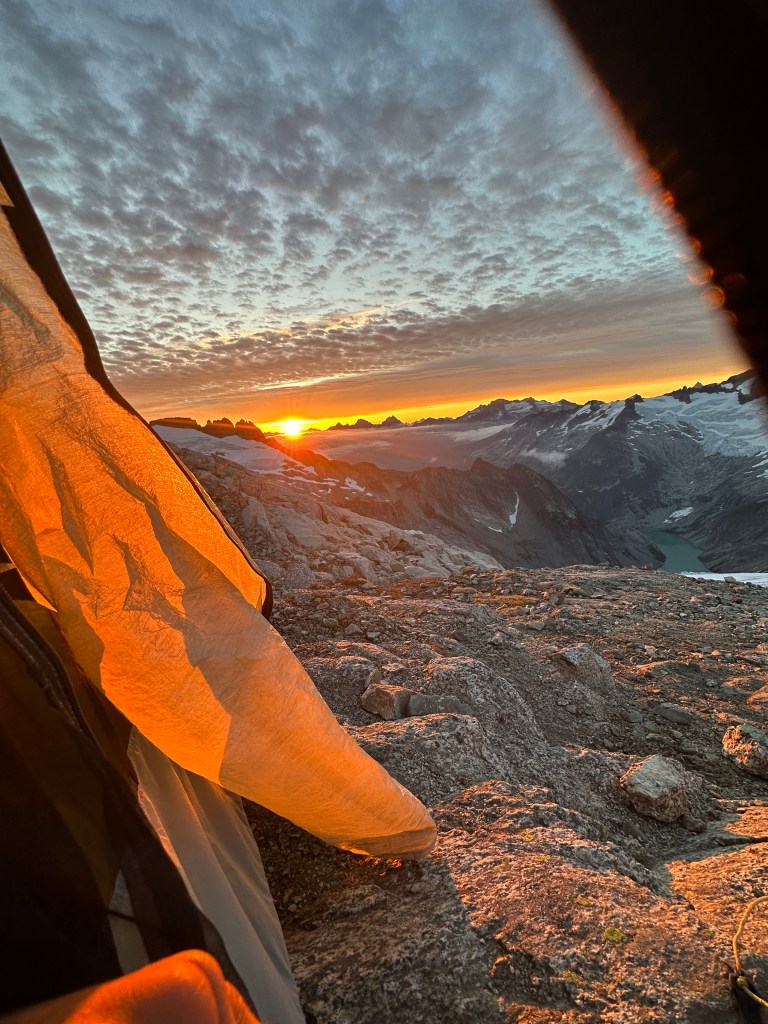
Views from camp

Previous trips to the zone yielded heinous weather, post-holing nightmares, and sideways rain. This morning broke way to a truly beautiful sunrise, promptly heating up the day. Our objective for day one of climbing was The East Ridge from the Toe (AKA “sit-start”) on the Dorado Needle. Combing through a plethora of beta on the internet, I learned an AMAGA Advanced Alpine Guide Course at camp, which had participants climb the route the day prior. Receiving final reassurances on the quality and condition of the route, Sarah and I boogied across the Inspiration Glacier, passing over its col on the Klawatti Glacier, arriving at the base in roughly 90 minutes. 

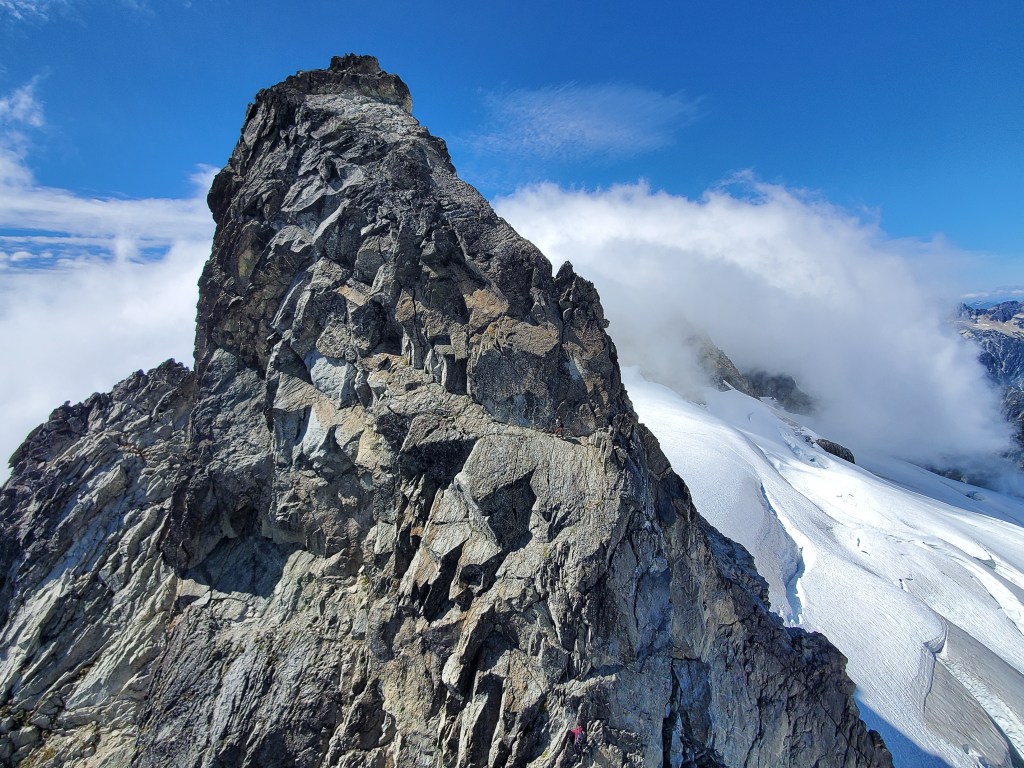
The Dorado Needle dominates the skyline. Our route follows the East Ridge, which appears to be the South in the photo.

Climbing the East Ridge sit-start involves an initial 600’ or so of climbing up to 5.6 on decent rock. Beginning with exposed moves directly off the glacier, I felt energized to be back in the saddle of alpine guiding. Especially on sight guiding! Continuing forward, we short-roped and pitched the next 500’ of climbing on low fifth-class terrain following boot-prints of previous climbers and broken terrain. Arriving at the infamous “CB,” we were moving quite well through the first third of the climbing. 

Sarah in front of the infamous CB!

Cruising in alpine terrain, we’re psyched!

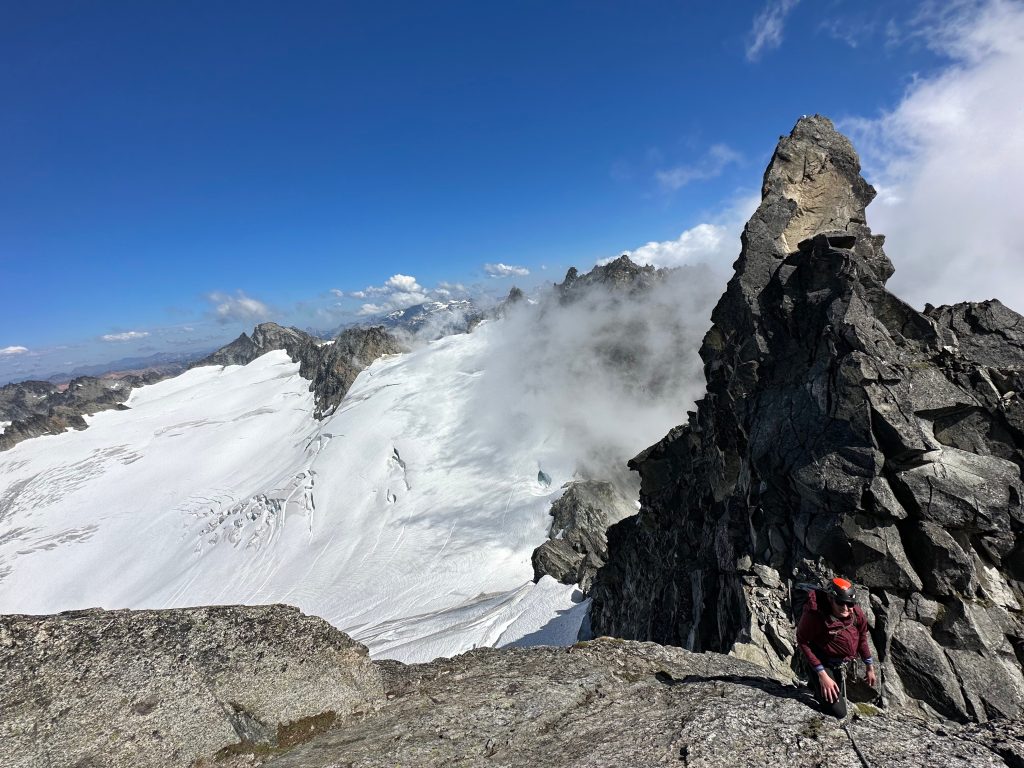
The second third begins with stepping onto the glacier, then regaining the rock and climbing to a gendarme just before the headwall. Navigating the transitions between rock and snow was trivial in our conditions; however, I can imagine that section not going in later season conditions. This next section of rock was admittedly underwhelming. Most of it was 3rd – 4th class, though, featuring tons of scree and loose rock, so movement proved tenuous in a guiding context. Erroring to climber’s right and avoiding dropping too low, we arrived at a fun & secure 10’ section of vertical climbing, gaining the tow of the gendarme. Belaying Sarah up to here and then down to the base of the gendarme was superbly exposed! Soaking in the surrounding views, we were delighted with the route, and its exposure, even through all the loose bits. Reports on the rappels of the gendarme were scant. Eventually, I found the first, only 15m skiers’ right of the initial rappel, and the next touched you down to the base of the headwall. Along these rappels, you can observe the headwall pitches directly across the notch, which looked intimidating for only 5.7. Pulling the ropes also proved quite dubious, considering the strong and gusty wind, but luckily enough, we got them down, slurped down some snacks and water, laced up our climbing shoes, and blasted up the money pitches!

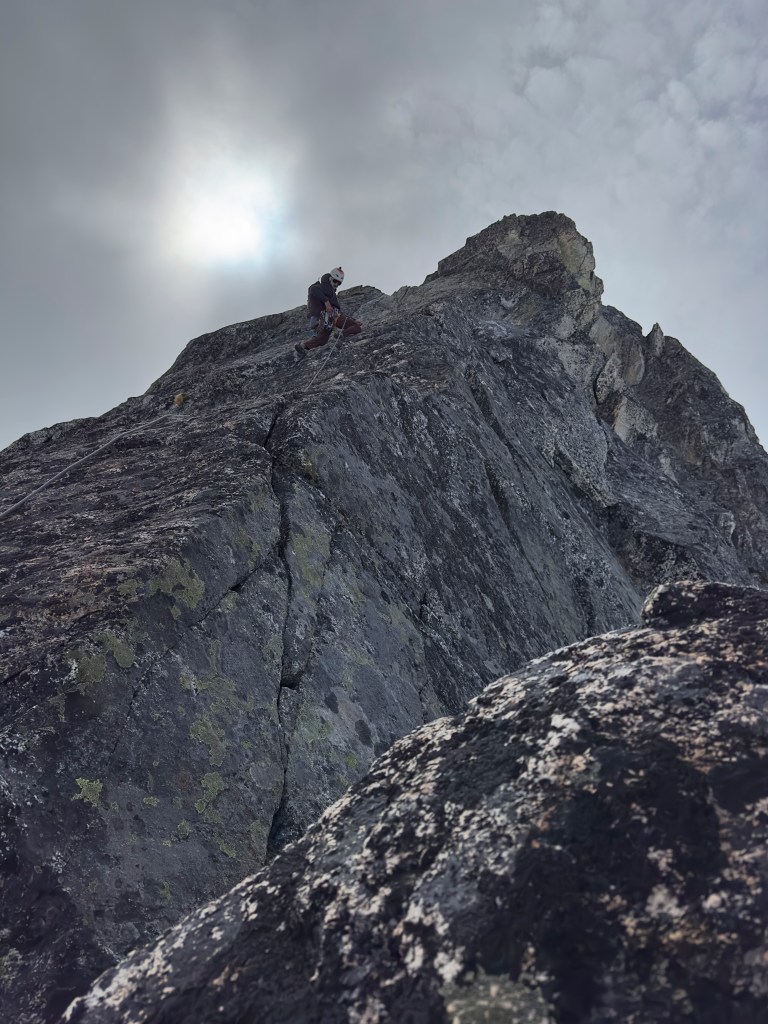
You can see me belaying Sarah up on the first money pitch. Hard to believe it is 5.7 from this angle.

Up to here, I had been climbing in my mountain boots, but the desire to feel nimble and agile won me over. The AMGA participants reported climbing in their boots, which seemed possible for me, though I had much more fun in my shoes. Clipping an old piton ~8’ off the belay, the terrain gave way to good exposure and mostly solid features. Before I knew it, I reached the belay ledge (as seen above), only to see my friend Kevin and his two clients top out the gendarme!

Looking back on the gendarme/ rappels.

The following money pitch was relatively short; at least, I broke it up for a fantastic photo opportunity. Great broken-finger cracks led to a brief hand/fist crack ending on a sizeable ledge with ample anchor options. The rest of the climbing to the summit was 3rd – 4th class scrambling, albeit exposed. The descent, however, was something else. To avoid a play-by-play review, I will leave the descent as an adventure for you to discover as I found it a fulfilling challenge to onsight. Cheers. 

Sarah topping out the final money pitch, with the gendarme behind.
I couldn’t help but ask Sarah for a money shot of me on the final pitch.

Dancing with Takhoma

Takhoma 09.17

            Opening up our new pajamas on Christmas Eve, elaborate Halloween decorations throughout the house, there some things my family just does. Most of us play volleyball, basketball or were runners in high school. I fell into this last category as I have poor hand-eye coordination. Competing in Track and Field in Spring and Cross Country in the Fall, running was a focus of mine year-round. One summer I recall we ran at least or close to 1,000 miles, I am still quite proud of this. While in school I was unaware of this incredible gift my coaches, Phil “Mister” English, Robert Price and Antony Stewart showed me. Molded by the intense summer heat, I owe my passion and inclination for endurance sports to these mentors and my setting. One tradition I was never taught though was dancing in pow wows. Both my sisters, my mother and my three uncles danced and competed in pow wows. This tradition was something I would have to seek out for my own and adapt my energy toward. All of my energy had been devoted to running in the streets, then trails and these days in the mountains. Please, let me tell you a story of how an Urban Native taught himself how to dance at the feet of Takhoma.

My red ribbon shirt – traditionally worn by dancers during pow wows. Seen here while skiing down Kulshan via the Easton Glacier.

            As I press for more adventures in the alpine, I continue discovering how connected everything is. It is one thing to have this told to you by an elder but quite another to experience it. Recently, I experienced a new perspective of a common phrase in Indian Country – All my relations. On Thursday July 23rd I set out from Me-yah-ah Pah, an old Yakama hunting ground on the East side of Takhoma. My goal was to explore parts of the Northern Wonderland Trail. Like dancing, no one had told me of Me-yah-ah Pah or its significance for my people. Often, I think of when my ancestors visited this place, the source of water and life, Takhoma. All of my relations, past, present, future even. Those current, The Cowlitz, Nisqually, Puyallup, Suquamish and Muckleshoot visit Takhoma from the West. But how do fit into this saying – all of my relations. How do I relate to all my relations? Unsure of my own connections, it found me on a long run where I started at none other than Me-yah-ah Pah. I will not ever forget the sunrise. Crimson and salmon-pink rays glowed on the upper mountain as I sipped instant-coffee and munched on blueberries. Between all of the sights and smells, I knew I was in for a good, long day of my favorite thing in the world in a place which has been home to me before I have even walked these plane’s or climbed to the top.

Crimson and salmon-pink rays on a day of skiing w/ Micheli Oliver – Photo by Micheli Oliver

            Visiting the top about a dozen times before then so much was left to learn. The true gift of Takhoma does not lie at 14,410’, it lies all around him. It has taken me a long time to figure this out, but I am learning to sit in this growth I have gone through. Don’t get me wrong, I am still driven to get to the top of places. I just know I will learn more if it is not my priority and, on this day, it was all about learning and seeing. Bounding up and down the valleys was unforgettable. Spending most of the day in long sections of being alone, the open rolling spaces kept me from feeling it. Throughout the whole day, no matter how tired, thirsty, hungry or whatever, I always felt like I belonged there. This feeling kept with me pushing into the 13th hour of the day. Driving up in elevation and mood, the discomfort of this run had been unlike any before. Just as the sun was setting, I headed back to Me-yah-ah Pah. As if the day were turned upside down and reversed, the sky looked the same but felt more familiar this time. Striding out the downhills and plopping my legs in a grinding walk uphill, I threw up a Black Lodge Singers album on my phone – something I enjoy doing every now and then. I was always curious why my grandpa, mom or my uncles enjoyed listening to pow wow music, but they had danced in their lifetime. Maybe that’s why they enjoy it. The stadiums full of people, drummers, dancers, singers, everything. Sitting there always as a spectator was me with my grandparents who hardly danced in their elder years. But this day, I was the only person in the stadium. Running to the beat now, my heart and the drums were competing for the tempo only to succumb to the terrain but, even then I stayed on beat with Takhoma, we stayed on beat together.

P.S. See this Strava Post detailing the stats on my run!

Black Lodge Singers closing the day out

The Pride from Wy’east

Under the tutelage of elders who carried us into times which make us proud to be Indian – we must serve those to come by making everyone accepting of Indians.

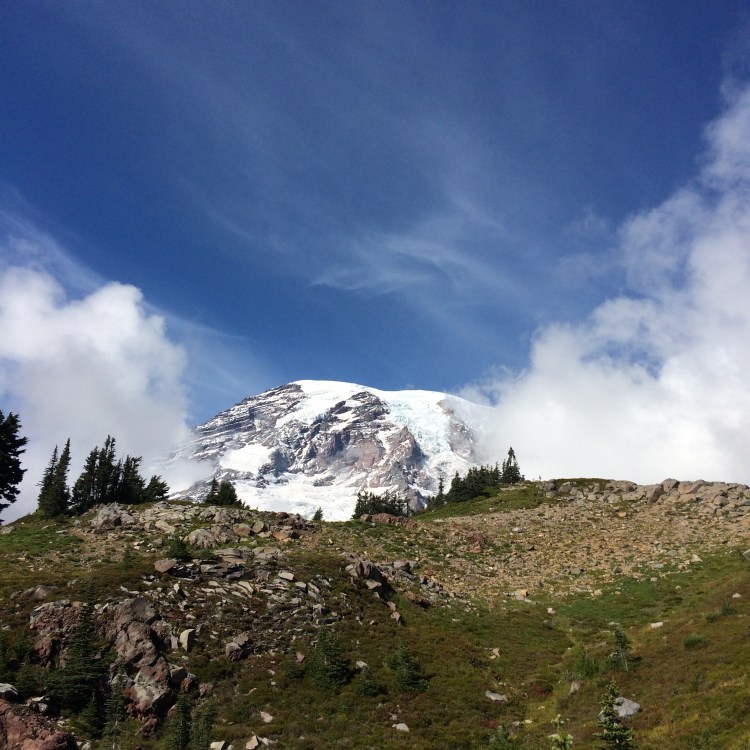
            Resting easy over the Yakama Nation, Pahto has provided for our people since time immemorial. Standing at 12,280’, Pahto’s gentle Southern rising slopes attract hundreds of amateur mountaineers and skiers alike; though, most only know its English name, Mt. Adams. Growing up my grandfather told me stories of her relations with the other snowy peaks of the region. In one story, the Three Sisters that are Pahto, Kittitas and Wy’east all bid and feud for Takhoma’s adornment. However, the plague of colonization has since removed the language, land and people from one another. Seeking to decolonize and reclaim these sacred places, my brother Owen Oliver of the Chinook People and I began with Pahto in October of 2019. Though on a fine sunny and windless day the summit remained out of reach leaving our ceremony incomplete. Transitioning to Spring, stories shifted toward Wy’east – whose pride pours over our ancestral homeland.

Owen and I Indigenous Peoples’ Day 2018

            August of 2016 was my last visit to Wy’east, when my interest in mountaineering had just began. Not much younger but much more brash and ignorant to consequences of mountaineering, my friend Carter and I were ill-prepped. Foregoing crampons under the impression the Pearly Gates was an easy 3rd class snow chute, we chugged up the resort as one does to find bergschrund in firm conditions. Yet we pressed on. Tip-toeing on the edge of the ‘schrund, cutting steps exacerbated the raining rockfall. Considering the overhead hazards, we opted to stay a bit climber’s left. In full swing with my adze, a whistle shot past my head. Thinking we were safe from any rockfall, Carter’s ghost-white face tells otherwise. Utterly unprepared for this route, numerous red-flags kept rising as we kept ignoring them. But at the time we did not know otherwise and felt committed. Pressing forward, this was the first summit both of us regretted obtaining as the down-climb would be equally as troubling.

Owen at Illumination Saddle

            Taking a sip of coffee while telling this story to Owen, I hoped to impart some wisdom, or maybe reassurance that I have seen some shit or something to justify my mistakes. As if I were an aged warrior struggling to remain consequential… but I cannot find anything. Instead, this story simply highlighted my mistakes, ignorance and luck. My immaturity especially in the mountains. For our journey to Wy’east, I am not much older, still as brash in some ways, but have developed a head about me. I am more in tune with my actions and their consequences, but most importantly – in tune with who I am separate of my passion for being outside. Before, I walked with all the invincibility a 19-year-old thinks they have. Unnerved by this ignorance on a wild ride into the night. Though, along the way maturity got a firm grip slapping me straight. I am grateful it did not come through a physical punishment. The source of the growth was spurred by a University trip to Southeast Alaska in the small village of Hoonah. Gathered around a table with my peers, my professor and a few elders listened to Bob Starbard, CEO of the Hoonah Indian Association (HIA). “Preserves are for berries, picked and sugar coated. Perpetuation is the answer.” – with respect to my question of how one may preserve Indigenous Culture(s). Unaware of the gravity of his words, I am learning to unpack them with my own discovery of ceremony.

Owen ascending The Pearly Gates

            My perspective of how I recreate and move in the backcountry is shaped by everything else in my life. It sounds silly to state, but it is important that I continually remind myself. Upon starting these sports, I was fueled and directed by athletic performance – my roots of distance running in high school are obvious. However, I now feel strong enough to own this energy and redirect it toward contemporary methods of ceremony. Seeking to re-engage in reciprocity with the Three Sisters, Takhoma and others, my gift is not an ability to move quickly and efficiently in such places; rather, to reconnect with all of my relations physically and spiritually. Recalling Owen’s first interest in such sports, I was unaware of the energy he would bring along these journeys. Before, my memory of Wy’east was clouded by a need to conquer and claim victory. Influenced by a settler-colonial mindset to tame land and its wild spaces. Now, through Owen’s pressing of my knowledge and growth, my vision is clearing. Standing proudly with my brother and Wy’east, the spring sky illuminates our respective homelands from the summit – The Columbia Plateau and the Columbia River. Considering my revitalized connections with these relations, I feel if I were to not share, to not confidently and proudly hold my space in these sacred places, I sugarcoat my existence and collective Indigenous culture.

A Letter to those Seeking Takhoma’s Summit

Early light on Takhoma

            The allure of Takhoma has long preceded the brutal conquest that replaced names of its features with names adapted for the English tongue. Ascending its trails and traversing its glaciers with these adapted names lures us into forgetting the history carried in this land. Naming is a central act of building a long-standing connection with the landscape; with this power, connections and long-standing ones can be severed. Takhoma, known as Mt. Rainer in English, has been a feature of allure long before the colonial conquest of these lands. The conquest of these lands also extended to the highest summits and consequently fostered the culture of climbing we have inherited today. Even though I, a native person, once set out to conquer this sacred mountain for selfish intent, I have educated myself on this sacred place’s original caretakers and name-givers. This original name reflects an ethic of reciprocity. Before I learned about this relationship of such things, I sought to only take from his — Takhoma’s — hands to put into mine. However, personal growth and education have opened my hands, and as I now raise them to him (Takhoma) in thanks, I reach out to help others grow and learn as I have.

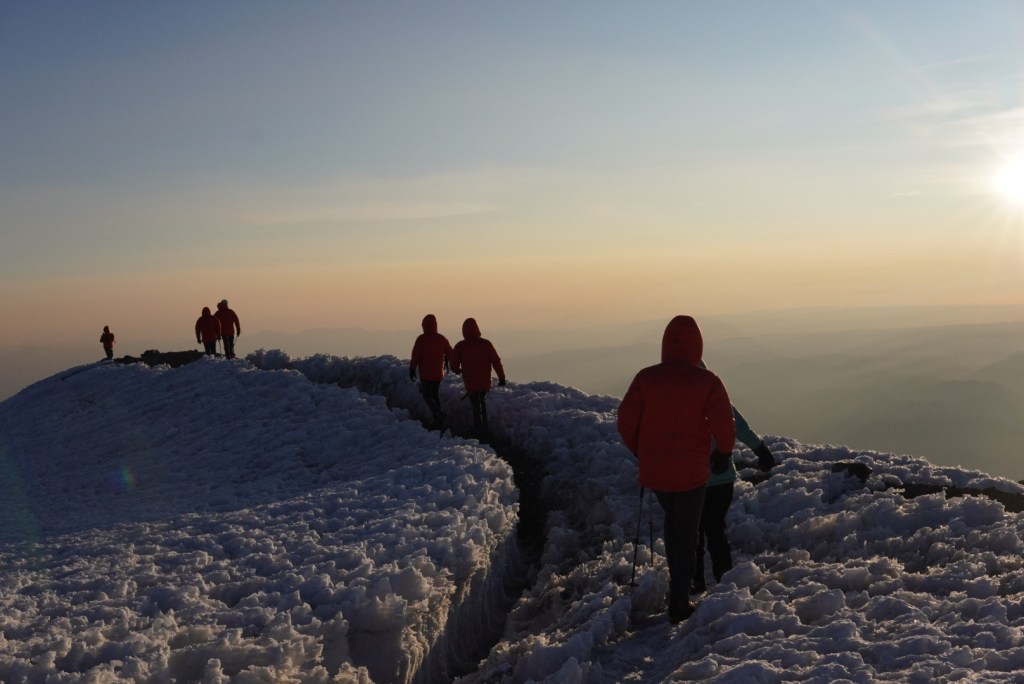
Summit sunrise

           If you also seek the summit, educate yourself on the history and facts behind the Indian removal from these lands. Acknowledging the removal of children from their families and the cultural genocide at boarding schools like Fort Simcoe on the Yakama Reservation is a pathway toward reparation and justice. Within education and awareness of these atrocities lay justice for the Yakama People and solutions to work together as different communities share spaces on Turtle Island. One easy thing you all may do to work for this is to begin your journey of education on Indigenous erasure here within Takhoma’s reach. I enact this responsibility as the next Cowlitz and Yakama Mountain Guide, following Chief Sluiskin’s legacy. Aspiring to heighten Indigenous voice and presence on Takhoma, I seek to perpetuate the teachings and wisdom of elders like Sluiskin. However, it cannot be completed without education on Isaac and Hazard Stevens’ roles with the Indigenous Peoples of Washington. As the Governor of WA in the 1850s, Isaac oversaw the murder of Chief Leschi and the atrocities of the Yakima Wars. Whereas Hazard partook in Indigenous erasure on his ascent of Takhoma, effectively contributing to a stereotype of Indian culture being dead and stuck in time. I imagine my life was not envisioned by Chief Sluiskin of the Yakama and Cowlitz Nations, although I am sure he would be proud. I am another Yakama and Cowlitz Mountain Guide on Takhoma, where Sluiskin was the first. This legacy I work in would not exist without him (Sluiskin), though its barriers were established by Isaac and Hazard Stevens’ legacies.

Guided group on the summit

          My people, the Yakama, would visit Me-Yah-ah Pah in the spring as a fairweather village; they would subsist off the land, living close to our mother of water and life. My people, the Yakama, sought their Honorable Harvest on the mountain’s East side. Engaging in seasonal hunting, berry picking, and ceremony, the Yakama are a few of the many who continue to give thanks to Takhoma. Through time, foreigners’ intense curiosity for exploration grew into greed for conquering nature. Sieging to ‘tame’ the ‘wild’ nature, colonizers imposed new purposes for these sacred areas to only serve humans, breaking the engagement of reciprocity. This newly assigned purpose flows only through the path of greed and consumption. To the West of Takhoma, the Cowlitz, Muckleshoot, Nisqually, Puyallup, and Squaxin Islands remain stewards to their respective sacred lands. Formed and segregated as a national park in 1899, the boundary of more than 200,000+ acres was shaped by treaties established with these six nations. The Medicine Creek Treaty of 1854 and the Yakama Nation Treaty of 1855 are the de jure rule of what is now called Mt. Rainier National Park. These treaties continue to be ignored, neglected, and tarnished by those who call themselves ‘leaders’ of the established park. The National Park Service (NPS) stated in the Historical Overview of Indians and Mount Rainier that“…Mt. Rainier National Park, like other national parks, commemorated Indians’ past use of the area through Indian place names”; claiming this is a “white American fondness for Indian names’ as a ‘form of nationalism.’” This statement shows extreme irony and bigotry as Indian names, words, culture, and identity were meant to be killed in boarding schools with the motto – Kill the Indian, save the man.

Native Americans were ultimately removed from the proximity of Takhoma while settlers moved in and began their conquests for the summit, a place previously not for the two-legged. In the days of Sluiskin of the Upper Cowlitz, Chief Si’ahl of the Duwamish from which the city of Seattle is named, Takhoma’s summit was not a place for the two-legged. A Yakama story I have read tells of a man once who pushed to the summit in the name of greed. Upon reaching the summit, he found Takhoma’s riches but was warned of the cost of his greed and selfishness. Along his journey, this man lost the way of his elders and community. He forgot his people’s ethics and the respect you give back to the land. In the story’s resolution, the man re-buries the treasure for no one, not for someone else to find, as it only belongs to Takhoma. Desiring to own and have control of the domain over Takhoma is dubious. I do not own Takhoma even though my people have been around since time immemorial. Instead, we are stewards watching over the well-being of the land and the continuation of it for the sake of future generations and all to benefit from.

Experiencing the nourishment and nurture of being on the land, I now know I am not the only Urban Indian who may connect to their culture. You see, I did not grow up with my community or my culture. I grew up in the city, an urban environment detached from other Indigenous people and cultures. Until I had made connections and relationships with the land, my Indigenous identity meant nothing more than an enrollment number and I.D. Just the way the forces of colonization had planned. But upon overcoming this systemic barrier and oppression, I know I am not alone, and others need space to move up. Through this new perspective gifted from Takhoma, there is something the two-legged can learn and pass on if an understanding of reciprocity is upheld.

Lower-Cowlitz Glacier seen from Muir Peak

It was not until I received an education from my peers, elders, community, and mentors that I earned this treasure — A commodity more valuable than buried gold — and it is my turn to pass this wisdom on. To the other two-legged who seek to conquer the wilderness, to the Urban Native kids who do not have community or identity. To my clients when they rope up with me. To those who seek Takhoma’s summit. During my days of peak-bagging and ‘conquering’ mountains, I, too, was lost like the Yakama man, searching for mythic treasures buried high on mountain summits.  This gift is never truly yours; it belongs to the next person to come and to those behind them. It may come in self-restoration after trials and tribulations or after a sense of accomplishment over triumphing physical or mental boundaries. Whichever it is, once you find it with Takhoma, be sure not to wield it. Knowledge and education are not weapons. Walk with it. Share with those in your community what you will do with this new knowledge. Utilize what you were gifted to educate your family and community because making them aware of the journey will spoil Takhoma’s gift.

Whether you reach the summit or not, Takhoma has given you energy. I ask that you redirect it so that it may enrich others.

Sincerely,

Cal’ James Smith, grandson of Red Smith of the Yakama and Yvonne Vivette of Grand Ronde

Guided group listening to Yakama story